To decide between the foundation types Given the available options, the structural design depends on three basic answers: how the soil behaves, what load the building will transfer to that soil, and whether there is a water table close to the surface.
The combination of this information, gathered before construction begins, indicates whether the project requires a shallow foundation or a deep foundation. Within each group, the technical manager determines which solution best suits the project.
There are shallow foundations, such as footings, raft foundations, and foundation beams, indicated when the soil near the surface has sufficient bearing capacity. Piles and caissons, on the other hand, are used when this resistance is present in deeper layers.
The choice between foundation types is not based on design preference. It responds to a set of technical data gathered before the concrete pouring.
The three most important factors are the soil profile, the load that the building applies to the ground, and the position of the water table.
Soil with good bearing capacity in the first few meters usually allows for shallow foundations, which are simpler to construct. However, soils with soft clay, uncompacted fill, or organic material typically require deeper support.
This data does not come from a visual estimate of the terrain. The soil investigation reveals the layers, resistance, and presence of water in the subsoil.
The foundation also needs to interact with the materials that make up the structure. Therefore, the choice of Types of steel in civil construction It affects the safety, durability, and performance of the work.
Without data on soil, load, and water content in the area, the choice of foundation becomes guesswork.
Shallow foundations, also called shallow foundations, transfer the load of the building to layers close to the surface. They generally appear when the soil has sufficient resistance in the first few meters.
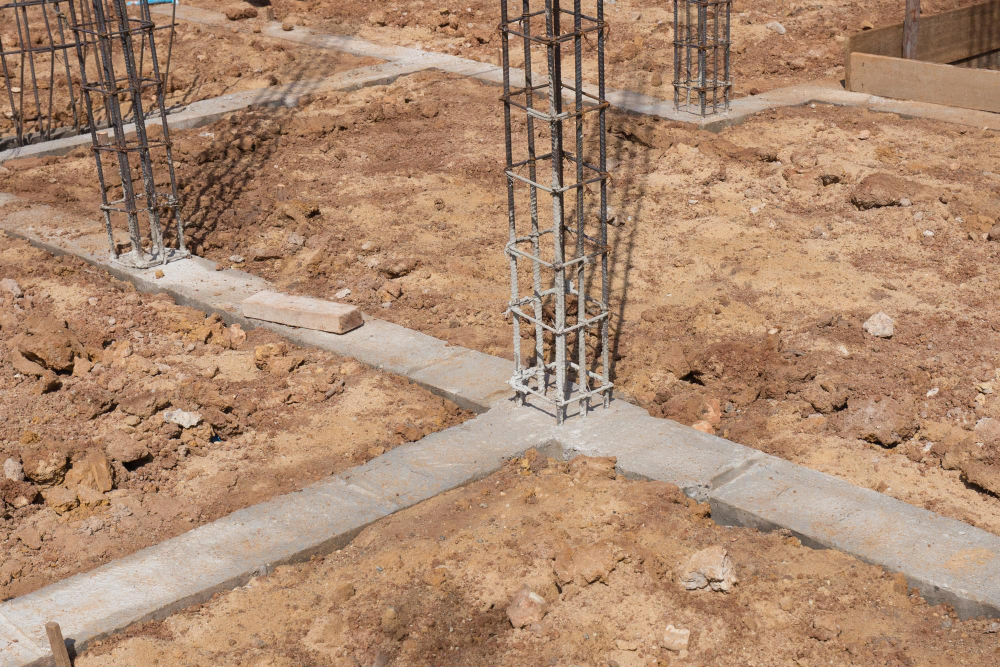
A footing is a reinforced concrete block positioned under columns or load points. It distributes the load to the ground and is commonly found in moderately sized residential, commercial, and industrial construction projects.
The raft foundation replaces individual footings with a single reinforced concrete slab. This solution distributes the load over a larger area and can be used when the soil has more homogeneous bearing capacity.
A foundation beam connects footings or blocks, braces the structure horizontally, and supports masonry walls. It rarely works alone as the main foundation.
In footings, raft foundations, and foundation beams, the reinforcement in steel rebar It helps the concrete resist tensile stresses, since concrete performs better under compression.
Shallow foundations can be economical and efficient, provided that the soil near the surface can support the expected load.
When the topsoil does not offer sufficient resistance, the project may resort to deep foundations. These seek support in more resistant layers, located several meters below the surface.
Piles are one of the most commonly used solutions. They consist of long, slender elements, driven or excavated in the ground, that transfer load through lateral friction and by their tip resting on a resistant layer.
There are precast piles, driven with specialized equipment, and cast-in-place piles, excavated and filled with concrete. The choice depends on the soil, the available space, the surrounding area, and the permitted vibration level.
The caisson has a larger diameter and may have an enlarged base to increase the support area. It is commonly used in projects with concentrated loads, such as bridges, tall buildings, and special structures.
Deep foundations tend to require more equipment, specialized labor, and executive control. They are rarely chosen out of preference.
They are included in the project when the soil or load does not allow for a safe shallow foundation.
Not all soil behaves the same way under load. This difference is one of the main reasons why there are so many types of foundations.
Well-compacted sandy soils tend to offer good drainage and bearing capacity. In these cases, shallow foundations may be feasible, provided the design confirms this condition.
Clay soils vary considerably depending on moisture content. Soft clay can have low strength and high compressibility, increasing the risk of differential settlement.
Recent landfills, soils with organic matter, and terrains with a history of erosion require greater attention. In many cases, these layers cannot bear direct load.
There can also be variation within the same plot. One area of the land may show good resistance, while another reveals soft clay or poorly compacted fill.
This is common in lowland areas, coastal regions, and land near former waterways.
The survey needs to investigate the actual terrain of the construction site, not just the behavior of neighboring lots.
The soil shows what the terrain can support. The building's load shows what the foundation needs to transfer to it.
A single-story house transmits a relatively low and distributed load. In many cases, footings or raft foundations can adequately serve this type of project.
Buildings with multiple floors, silos, warehouses with overhead cranes, and industrial structures concentrate greater loads at specific points. In these cases, the foundation may require reinforcement, greater depth, or more robust reinforcement.
The dimensioning involves the volume of concrete, reinforcement ratio, bar gauge, and arrangement of the rebars. These elements must follow the structural calculations.
When the project uses CA-60 rebar, The specification must comply with applicable technical standards so that the steel delivered to the construction site meets the expected standards.
Current load and potential future expansions should be factored into the analysis. A foundation designed only for initial use may limit future renovations.
Sites with a shallow water table add another variable to the choice of foundation. Water in the soil can reduce bearing capacity, hinder excavations, and generate thrust on buried elements.
This scenario frequently appears in coastal areas, lowland terrain, and regions near rivers.
Footings and raft foundations can still be used in some cases, but they usually require drainage, waterproofing, and temporary water level control during construction.
When the water is very close to the surface and the saturated soil has low resistance, piles and caissons can be evaluated by the responsible technician.
The definition should not be based solely on observations of wells, ditches, or neighboring land. The water level varies according to the season, rainfall, and proximity to bodies of water.
The survey indicates the actual depth of the water table at the construction site and reduces the risk of an unsuitable choice.
Many structural problems related to foundations begin before the calculations are even done. These are decisions made to speed up construction, reduce initial costs, or simplify the contracting process.
The most frequent mistakes are:
In public works, industrial projects, or projects of greater technical responsibility, the use of certified steel It also helps reduce the risk of out-of-specification supply.
The cheapest foundation in the initial budget can become the most expensive part of the project if the soil has been poorly assessed.
Soil investigation is a technical survey that describes the layers of soil, their resistance, and the depth of the water table.
One of the most widely used methods is the SPT, which drives a standardized sampler into the ground and records the number of blows required to advance it. The result indicates the soil resistance at different depths.
The soil investigation report shows the subsurface profile, the type of material in each layer, and the water table level encountered. With this information, the engineer calculates the bearing capacity and defines the foundation.
Without this report, the choice depends on local experience, the appearance of the land, or comparison with nearby projects. This increases the risk of undersizing and unnecessary spending.
The number of boreholes and the depth investigated vary according to the size of the building, the constructed area, and the history of the land.
Soil investigation is not just for choosing between shallow and deep foundations. It guides the design, execution, and risk control of the construction project.
Regardless of the type of foundation, steel reinforcement ensures an essential part of the performance of reinforced concrete.
Concrete resists compression well, but it depends on steel to resist tensile forces. Therefore, footings, raft foundations, capping blocks, foundation beams, and caissons use reinforcing bars sized according to the calculations.
The specification should indicate the gauge, category, spacing, position, and minimum concrete cover. This cover protects the reinforcement against moisture, soil aggressiveness, and corrosion.
The fastening of the armor with annealed wire It is also necessary to keep the reinforcing bars in position until the concrete is poured. Displacements during execution can alter the concrete cover and compromise the expected performance.
In aggressive soils or areas near the sea, the project may include additional cover or specific protection, as determined by a technical assessment.
The reinforcement cannot be improvised on the construction site. It needs to follow the design, dimensions, and positioning defined in the structural project.
The purchase of steel for foundations should begin with the structural design. Gauges, categories, lengths, bends, quantities, and deadlines need to be defined before requesting a quote.
Buying only "foundation rebar" without detailed information can lead to delays, surplus, lack of material, or delivery that is inconsistent with the project.
It is also necessary to check the batch documentation, the identification of the bars, and their compatibility with the specification. Quality and traceability are even more important in elements that will be buried and cannot be easily inspected after concreting.
Another important consideration is storage. The steel should be kept off the ground, protected from mud, excessive moisture, and contaminants that could impair its adhesion to the concrete.
In projects with a tight schedule, the purchase of steel for industrial works and projects You need to consider quantity, logistics, concrete pouring fronts, and availability per phase.
The foundation is laid early, but it supports the entire lifespan of the building. Therefore, the purchase of steel should not be treated as a secondary step.
Comparing foundation types solely based on cost of execution can lead to expensive decisions in the future.
A shallow foundation on unsuitable soil may seem advantageous in the initial budget. However, settlement, cracking, reinforcement, and work stoppages can outweigh the price difference compared to a well-designed deep foundation solution.
The total cost includes surveying, design, materials, labor, equipment, execution time, drainage, and the risk of corrective maintenance.
Deep foundations typically have a higher initial cost. In soils that require this type of support, this cost reflects the actual complexity of the terrain.
An oversized foundation also increases the cost of the project without a proportional gain in safety. The design needs to find the right solution, not the heaviest one.
The best type of foundation is one that responds safely and cost-effectively to the soil, load, and use of the building.
The choice begins with soil testing. Without this data, there is no sufficient technical basis to decide between footing, raft foundation, foundation beam, pile, or caisson.
Next, the structural design considers soil resistance, building load, water level, building use, and the possibility of expansion.
The calculation also takes into account deadlines, machine access, impact on the neighborhood, execution costs, and the availability of skilled labor.
A shallow foundation may be the best solution for a single-story house on firm soil. A deep foundation may be essential for a warehouse with concentrated loads on weak soil.
No type of foundation is universal. Each project requires a unique assessment of the terrain and the structure.
The right decision arises from the combination of soil study, structural calculation, material specification, and controlled execution.
After defining the type of foundation with the technical expert, the next step is to specify and purchase the reinforcing steel.
At Aço Cearense Comercial, we distribute reinforcing bars, wire mesh, and welded wire mesh for footings, raft foundations, foundation beams, capping blocks, and other foundation elements.
We work with various gauges and categories to meet the needs of residential, commercial, and industrial projects, always in accordance with the technical specifications of the work.
To compare product information, Download our complete catalog.. With the quantity of steel defined, request a Get a quote from our team., specifying gauges, quantities, and project timeline.
Shallow foundations transfer the load to layers close to the surface, as occurs in footings, raft foundations, and foundation beams. Deep foundations seek support in more resistant layers located at greater depths, such as piles and caissons.
It's impossible to make a definitive decision without real-world data from the site. Neighboring construction can indicate a trend, but it doesn't replace soil testing, which measures soil resistance and the position of the water table.
Yes, it can. An undersized foundation can cause differential settlement, cracks in walls, misaligned doors, and, in severe cases, compromise the stability of the structure.
Larger projects generally require formal soil testing. Even in smaller constructions, soil surveys help avoid decisions based solely on local experience, especially on filled land or near rivers.
No. The cost should reflect what the soil and load require. Unnecessary oversizing increases the cost of the project without any real gain. Safety comes from correct dimensioning.
Yes. The same plot of land can have sectors with different behaviors. The project can combine solutions, provided that the technical manager assesses settlements, loads, and transitions between the systems.
Reinforced concrete foundations typically use rebar specified in the design, with specific gauge, category, and spacing. In raft foundations and foundation beams, welded mesh and wire mesh may also be used, depending on the calculations.