The use of metal structures in civil construction has been transforming the urban landscape and the way projects are planned, executed, and delivered. Increasingly, steel It is gaining ground as a structural solution by combining speed of construction, design flexibility, and the potential for more sustainable buildings.
Whether in industrial warehouses, commercial buildings, bridges, or more daring architectural projects, metal structures allow for less material waste and greater control over deadlines and costs. Therefore, understanding the types of metal systems available and where each one fits makes all the difference when designing.
In this comprehensive guide, you will learn about the main types of metal structures in civil construction, their applications, advantages, assembly processes, technical standards involved, and the main trends in the sector, understanding in practice why steel has become a key element in contemporary architecture. Building with steel is about reinventing possibilities.
The concept of a metal structure encompasses everything. construction system In which steel is the primary raw material for supporting loads and distributing stress in buildings. Whether in industrial warehouses, commercial buildings, walkways, or innovative residences, steel is becoming a leading material due to its durability, lightness, and versatility.
In addition to its high mechanical strength, the metal structure has a low weight-to-strength ratio, a characteristic that reduces the volume of foundations and allows for innovative architectural designs, with large spans and fewer pillars, offering spaciousness to the environments.
Steel allows for quick interventions, a clean construction site, and ease of disassembly or future expansion. This flexibility is valued by both engineers and architects, as it broadens the range of construction solutions and reduces common bottlenecks in large projects.
In practice, the construction industry explores various structural arrangements using steel. Each typology responds better to specific architectural and structural demands. Among the most common are:
Next, each of these solutions will be detailed, demonstrating its potential, limitations, examples, and main applications.
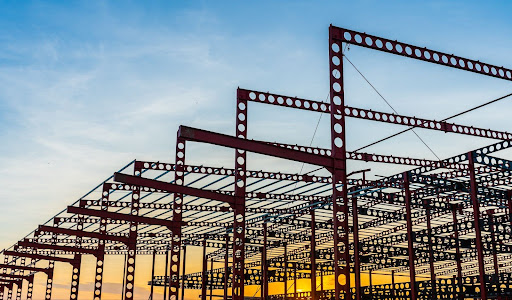
A metal gantry consists of a set of articulated or rigid beams and columns, designed to support large transverse loads and allow for wider spans. This solution is widely used in industrial warehouses, logistics centers, supermarkets, and hangars.
The absence of internal pillars is the main advantage of the metal portal frame, facilitating the circulation of people and goods, as well as providing complete freedom for the internal layout.
For those seeking more details about metal pillars and structural arrangements, the article on Types of pillars in metal structures It offers an in-depth overview.
To the steel trusses They are formed by linear bars interconnected in a triangular shape. This geometry reduces the self-weight of the structural system, while providing excellent resistance to heavy loads, especially in roofs and elevated walkways.
Metal trusses are suitable for projects such as gymnasiums, highway overpasses, and long-span roofs, where lightness and bending strength must be combined. Their assembly is usually done in modules, which speeds up construction and minimizes the use of temporary materials.
Residential projects, schools, mezzanines, and small buildings also benefit from steel through lightweight systems such as steel frame and I- or U-beams. The lightness of the components facilitates transport and assembly, allowing for fast, clean construction with less waste. The use of steel in modular solutions allows for complete customization, adapting to each site and project.
Tall buildings, bridges, shopping centers, and industrial facilities typically require heavy structural steel in robust profiles such as W, I, or H, with greater sheet thicknesses. These systems withstand high compressive loads and horizontal forces, making the construction of skyscrapers and iconic structures possible.
According to Federal University of Minas Gerais, the use of steel in Vertical buildings reduce timelines and costs, and facilitate future interventions thanks to the modularity of the structure..
Mixed structures combine the best of both worlds: steel profiles and concrete slabs/columns. This integration results in leaner structures, with thinner slabs and less bulky columns, expanding the usable interior space. This arrangement makes construction more economical and flexible, being one of the main approaches for current residential and commercial buildings.
Steel has conquered multiple segments of the construction industry. Some of the most common uses include:
Steel solutions offer several advantages over conventional methods using concrete and masonry, making them increasingly desirable for professionals in the sector. Understand some of the advantages of using structural steel in construction:
Metal structures reduce construction time, promote cost savings, and contribute to a cleaner and more sustainable project. The ease of assembly and disassembly also prevents waste in future renovations and expansions.
Although each system has its own particularities and ideal applications, the intelligent use of steel offers significant advantages over reinforced concrete in many civil construction scenarios. This is especially true when the project demands speed, flexibility, and resource optimization.
When comparing steel and reinforced concrete, the weight of the structure is one of the most striking factors. A building designed with steel structures It can be up to 40% lighter. than an equivalent solution in concrete. This directly impacts loads on foundations, stresses on structural elements, and even the logistics of transporting components to the construction site.
Lighter structures mean more economical foundations. In terrains with low bearing capacity or in projects that require strict load control, such as extensions to existing buildings, steel becomes a great ally. The weight reduction also contributes to lower material consumption and, consequently, less environmental impact.
Construction time is one of the areas where steel stands out most compared to concrete. Since a large part of the metal components are manufactured and pre-assembled in an industrial environment, the construction site becomes much more organized, with quick and predictable assembly stages. In many cases, the total timeframe for a steel structure can be reduced by half when compared to a traditional concrete system.
This industrialization allows several work fronts to happen in parallel. While the foundation is being built, for example, the steel structure is already being produced in the factory. When the elements arrive at the construction site, the process focuses on assembly, inspection, and finishing, with less dependence on wet stages, such as formwork, reinforcement, and concreting, which require curing time.
For commercial and industrial projects, where time to market is critical, this reduction in timeline can represent a significant financial gain.
Another important advantage of steel structures is the ease of customization throughout the building's life cycle. Layout changes, localized reinforcements, the creation of new spans, or the expansion of areas can be planned and executed with less invasive interventions when the main structure is made of steel. Elements can be bolted, replaced, or reinforced with less need for demolition.
In commercial, industrial, and logistics projects, this flexibility is especially valuable. Usage demands change over time, whether due to the addition of new equipment, the need to create mezzanines, or the expansion of storage areas. In a metal structure, it is simpler to adapt the design to accommodate these new requirements, while maintaining safety and performance.
In concrete structures, significant adjustments often require partial demolitions, cuts in beams and slabs, reinforcements with plates or fibers, all of which involve more dust, noise, risk of interference with installations, and higher costs. In steel, the logic is more modular and reconfigurable, which helps to extend the lifespan of the project and increase its ability to adapt to business changes.
From an environmental standpoint, steel stands out for its recyclability. It can be reused countless times without significant loss of mechanical properties, which promotes a circular economy and reduces the need to extract new raw materials. In many projects, some of the steel used even comes from recycled scrap, which reduces the carbon footprint associated with the material.
During construction, the use of metal structures also tends to generate less waste, since the components arrive ready-made, cut and drilled according to the project. This reduces leftovers, debris, and the need for rework. The cleanliness and organization of the construction site improve, which favors safety, quality control, and the image of the project in the eyes of clients and regulatory bodies.
While concrete can be recycled as aggregate for foundations and sub-foundations, it requires more complex crushing and separation processes, generally resulting in lower added value when reused. Furthermore, its production cycle involves significant water consumption and CO₂ emissions, primarily during cement manufacturing. Therefore, when the goal is to align structural performance, speed of construction, and environmental responsibility, steel becomes a more relevant and strategic choice.
Concrete structures are still preferred in situations where speed is less of a requirement or in small-scale projects, where the initial investment in steel can be higher. However, for those who value speed, cleanliness, and flexibility in the use of space, steel usually stands out.
The design and execution of steel in Brazilian buildings follow the guidelines imposed by the main national technical standards. The two main sources of reference are NBR 8800 and 14762.
Brazilian standard NBR 8800 establishes the criteria for the design and execution of steel structures and mixed steel and concrete structures in buildings. It defines safety requirements, limit states, load combinations, dimensioning criteria, and construction details.
Therefore, it serves as a basic reference for engineers working with industrial sheds, commercial buildings, mezzanines, walkways, and other metal structures. Following NBR 8800 is fundamental to ensuring adequate structural performance, durability, and compliance with legal and safety requirements.
NBR 14762 deals with the design of cold-formed steel structures, especially lightweight profiles used in buildings, enclosures and panels, such as studs, tracks, purlins and light steel frame systems.
The standard guides the calculation of these elements considering their geometric and manufacturing particularities, in addition to addressing criteria for stability, buckling, and connections. In practice, it is indispensable for projects that use lightweight profiles in roofs, partitions, and industrialized construction systems, ensuring that these solutions are safe, efficient, and suitable for their intended use.
Full compliance with these standards is essential to ensure structural performance, overall safety, and the longevity of the project.
In addition to regulations, the sector remains attentive to good manufacturing, transportation, assembly, and inspection practices for metal systems, investing in the ongoing technical training of the professionals involved.
Designing steel structural systems involves rigorous load analysis, proper specification of profiles, connection calculations, and detailing of critical points in the structure.
Accurate calculations and compatibility between architectural and engineering designs prevent rework and reduce the risk of structural failures.
The steel construction cycle in building projects follows well-defined stages, from fabrication to assembly, ensuring precision, speed, and safety on the construction site.
The assembly of metal structures is quick and requires skilled labor, capable of operating cranes, performing welding, and handling loads safely.
Steel is one of the few fully recyclable materials in the construction sector. During renovations, expansions, or demolitions, virtually 100% of structural profiles can be reused in new applications, saving natural resources and reducing landfill waste.
Committed companies, like the Aço Cearense Group, They invest in eucalyptus plantations to supply energy to their plants, promote the responsible use of steel, and support social projects, strengthening the positive impact on the communities where they operate.
This commitment further enhances the value of steel structures in the context of smart cities and green architecture, aligning innovation, social responsibility, and economic progress.
The construction market is constantly transforming, and steel plays a leading role in many of these trends. Some of the recent innovations and trends observed are:
Keeping pace with environmental needs, steel solutions contribute to reducing environmental impact, closing the construction cycle in a sustainable way.
The use of steel structural systems is already a well-established reality in major urban centers and in projects of all sizes. Speed, precision, sustainability, and design flexibility are the pillars that support the expansion of steel in modern civil construction.
For engineers, architects, developers, and business owners, understanding the variations, technical standards, best practices, and pathways for using steel is fundamental to innovating and ensuring the best results in residential, commercial, and industrial projects.
If you want to innovate and bring more flexibility to your next project, learn about... Steel solutions from the Aço Cearense Group and discover a universe of possibilities to transform your business.
Steel structures are construction systems in which steel serves as the main supporting element, transferring loads to the building's foundations. They can be composed of beams, columns, trusses, frames, and other custom-made components, suitable for various types of construction due to their strength, lightness, and flexibility.
Among the advantages are faster construction, reduced overall structural weight, savings on foundations, less waste generation, the possibility of disassembly and reuse of materials, as well as the flexibility to expand or modify spaces. It is also a sustainable system with a long lifespan.
The cost of a metal structure depends on factors such as type, size, profile thickness, construction site location, labor, and finishing. While the initial investment may be slightly higher compared to conventional systems, the gains in time and the reduction in indirect costs generate savings throughout the construction cycle. It is crucial to have reliable suppliers and a good executive project to optimize the budget.
Steel can be used in industrial sheds, logistics centers, high-rise buildings, walkways, bridges, roofs, schools, hospitals, sports centers, and residences. It is also recommended for renovations, expansions, and modular constructions due to its ease of transport, assembly, and disassembly.
The choice depends on the nature of the work, acting loads, span requirements, height, layout flexibility, and available budget. It is essential to consult a specialized engineer, who will evaluate each situation, indicate the material and system (frames, trusses, lightweight, mixed, etc.) most compatible with the project objectives, always following technical standards.