THE service life of metal structures It doesn't depend solely on the thickness of the steel. In many projects, increasing the cross-section of the components raises the weight and cost, but doesn't solve the underlying causes that accelerate deterioration.
Corrosion, water accumulation, inadequate coatings, manufacturing defects, and lack of maintenance tend to have the greatest impact. Therefore, we need to analyze the entire structure, from the choice of material to the actual conditions of use.
With an environmentally friendly design and a well-specified protection system, we can preserve the steel without unnecessarily increasing its thickness.
The thickness of the steel influences the strength and rigidity of the structure. However, it does not, by itself, represent a solution against corrosion.
When a part is continuously exposed to moisture, salts, or chemical agents, the corrosive process begins on the surface. Wear progresses gradually and can lead to loss of cross-section over time.
A thicker component allows for a greater amount of material to be lost before this loss becomes critical. Even so, corrosion will continue to occur if the cause is not controlled.
Therefore, increasing the thickness may only postpone the problem. Furthermore, this choice adds weight to the structure and may require changes to foundations, connections, transport, and assembly.
Structural design must comply with the loads, spans, and conditions specified in the project. Corrosion protection, on the other hand, must be appropriate for the exposure environment.
Therefore, we need to separate two concepts. A structural capacity It is related to the behavior of the part under stress. Durability depends on the ability to maintain this performance over the expected period.
A structure can have correctly sized components and still exhibit premature wear. This occurs when the design does not consider accumulated water, sea air, pollution, or maintenance.
There is also the opposite risk. Increasing the thickness unnecessarily can increase steel consumption without proportionally extending the lifespan.
Before modifying a section, we need to identify the deterioration mechanism. In many cases, drainage, coating, and inspection offer more efficient results.
Our content about steel strength and its characteristics It helps to differentiate mechanical properties and application criteria.
The service life corresponds to the period during which the structure maintains safety and performance compatible with its intended use. To achieve this result, several factors need to work together.
The first is the quality of the steel. The material must meet the class, dimensions, and properties defined by the project.
The second factor is the environment. A warehouse located in a dry region faces different conditions than a structure near the sea or a chemical plant.
We also need to consider the design of the components. Areas that accumulate water, debris, or moisture tend to suffer more intense corrosion.
Manufacturing interferes in a similar way. Cuts, welds, punctures, and contamination can damage coatings or create vulnerable areas.
The main factors that affect durability include:
These factors show that durability results from a system. No amount of protective layer can compensate for a design that allows water to accumulate on the steel.
Similarly, good geometry does not eliminate the need to protect structures exposed to harsh environments.
The content about Corrosion of steel and ways to prevent it. It explains how different conditions accelerate deterioration.
The environment determines how long the surface remains wet and what substances come into contact with the metal.
In outdoor areas, rain and humidity promote corrosive reactions. However, the intensity of the process varies depending on ventilation, temperature, and the presence of contaminants.
Sea spray represents a more aggressive condition. Salts carried by the wind reach the surface and can concentrate in cracks, joints, and areas protected from rain.
Industrial areas also require attention. Vapors, particles, and chemicals can attack the steel or the applied coating.
Even indoor environments can present risks. Warehouses with condensation, industrial laundries, and food processing areas maintain damp surfaces for extended periods.
Therefore, broad classifications, such as "indoor" or "outdoor," are not always sufficient. We need to consider the microenvironment where each piece will be installed.
A pillar protected by a covering can accumulate dirt and salts without receiving natural washing. A piece directly exposed to rain, on the other hand, can dry more quickly.
Geometry also affects water exposure. Horizontal surfaces retain more water than inclined pieces. Pipes without drainage can accumulate liquid internally.
Furthermore, areas close to the ground often receive moisture, mud, and cleaning products. Pillar and support bases require specific detailing.
In existing structures, signs of corrosion in nearby elements help to understand the environment. This observation can support the choice of protection system.
However, the analysis should consider potential differences in materials, age, and maintenance conditions.
THE ICZ galvanizing specification manual The durability of the coating is related to the exposure conditions and the thickness of the zinc layer.
Coatings create a separation between the steel and the environment. Some also offer additional protective mechanisms.
The paint acts primarily as a barrier. When the system remains intact, it reduces the entry of water, oxygen, and contaminants.
However, scratches, adhesion failures, and wear can expose the metal. Therefore, surface preparation and proper application are of great importance.
Galvanization uses a layer of zinc. In addition to providing a barrier, zinc can offer... sacrificial protection in small areas where the steel was exposed.
This behavior occurs because zinc tends to oxidize before iron. In this way, it helps protect the steel near the damage.
Hot-dip galvanizing forms layers bonded to the surface of the material. It is used in structures, railings, supports, profiles, and various components.
Galvanized sheets in continuous lines can be transformed into roofing sheets, light profiles, and metal cladding.
Our article about the galvanizing process It explains the main steps of this treatment.
Another way is the duplex system, This system combines galvanizing and painting. In this system, the zinc layer protects the steel, while the paint reduces the exposure of the metallic coating.
This combination can be considered when the environment is harsh or when the project requires a specific appearance. However, the paint must be compatible with the galvanized surface.
There are also sheets coated with metal alloys that combine zinc and other elements. These solutions can offer different performance depending on the environment and application.
The choice should be based on technical specifications, tests, and manufacturer recommendations. Generic commercial terms do not replace information about the composition and quantity of the coating.
Furthermore, the coating needs to adapt to the manufacturing process. Folds, cuts, and welds can create conditions that differ from the original surface.
A design focused on durability avoids conditions that accelerate corrosion. This strategy usually yields better results than increasing the mass of the parts.
The first step is to ensure proper drainage. Rainwater, wash water, or condensation should not be allowed to accumulate.
Profiles and plates need to be positioned to allow for drainage. In closed parts, drainage holes may be necessary.
The second precaution involves ventilation. Stuffy areas dry slowly and keep the surface moist for longer.
Narrow crevices also deserve attention. They retain water, salts, and debris, creating conditions favorable to localized corrosion.
Overlapping connections can form this type of region. Therefore, we need to evaluate sealing, continuous welding, or spacing between the components.
Contact between dissimilar metals must be controlled. In the presence of moisture, certain combinations can cause galvanic corrosion.
In these cases, insulating materials and compatible fastening systems help to separate the metals.
Accessibility is another important point. The design must allow for inspection, cleaning, and repair of surfaces.
Completely sealed elements can hide corrosion until the loss of cross-section becomes significant. Therefore, inspection openings may be necessary.
The detailing also needs to protect the bases of the pillars. Water and dirt tend to accumulate near the floor.
Solutions that raise the structure, facilitate drainage, and protect the junction with the foundation help reduce exposure.
On roofs, gutters and flashing need to channel water without directing it towards the structures. Recurring leaks can deteriorate purlins, connections, and supports.
Like this, draw to dry It is one of the most effective measures to extend the lifespan of metal structures.
The first step is to specify the steel according to the actual loads. Then, we must define the surface protection according to the environment.
This separation avoids the use of heavier parts simply to create a buffer against corrosion.
A properly dimensioned structure can be galvanized, painted, or treated with a combination of both. The decision depends on the level of exposure and the planned maintenance.
Another measure involves distributing the investment according to criticality. Not all parts face the same conditions.
Items directly exposed to rain may require superior protection. Interior, dry items, on the other hand, can utilize a simpler system.
This approach reduces costs without compromising durability. However, mapping needs to be done during the design phase.
The use of standardized components also helps. Commercially available profiles, sheets, and tubes tend to make purchasing, replacement, and manufacturing easier.
Furthermore, an efficient cutting plan reduces waste. Excess leftovers increase costs without improving performance.
Coordination between engineering, manufacturing, and assembly avoids on-site adaptations. Holes and cuts made after the coating has been applied require repairs.
Therefore, the more operations that are planned before final protection, the smaller the number of vulnerable areas tends to be.
We also need to compare the life cycle cost. An alternative with a lower initial investment may require frequent repainting.
In tall structures, maintenance access can represent a significant portion of the cost. Platforms, area isolation, and operational interruptions need to be factored into the calculation.
In these cases, investing in a more durable protection system can be advantageous, even without increasing the thickness of the parts.
Our content about technical support in the selection of materials This demonstrates how more precise specifications help reduce losses and rework.
Cuts and welds alter the continuity of the coating. Therefore, these operations need to be part of the manufacturing planning.
In coated sheets, the cut exposes the edge of the steel. Depending on the system, the surrounding protection can reduce corrosion in small areas.
However, extensive edges and damaged areas require treatment. The procedure should follow the material specifications.
Welding generates heat and can remove coatings near the joint. Additionally, spatter and residue affect surface quality.
After welding, the area must be cleaned and treated with the chosen repair system. Zinc-rich paints and metallization are among the possible solutions for certain projects.
The choice depends on the extent of the damage and the conditions of exposure. Applying any product without preparation does not guarantee recovery.
We also need to observe the geometry of the welds. Irregular welds and porous areas retain moisture and make painting difficult.
The manufacturing process must utilize clean tools. Particles of other metals can contaminate the surface and create corrosion points.
For parts intended for hot-dip galvanizing, the design must include ventilation and drainage. Closed cavities hinder the process and can pose risks.
The technical guide of American Galvanizers Association It provides recommendations for designing parts that will be galvanized after manufacturing.
Therefore, the coating should not be treated as an isolated step. It needs to be compatible with the geometry and the manufacturing method.
The structure may leave the factory with adequate protection and still suffer damage before installation. Transportation and storage must preserve the applied system.
During movement, chains, cables, and supports can scratch the surface. Intermediate guards help reduce direct contact.
The pieces should not be dragged over each other. This movement causes abrasion and can remove part of the coating.
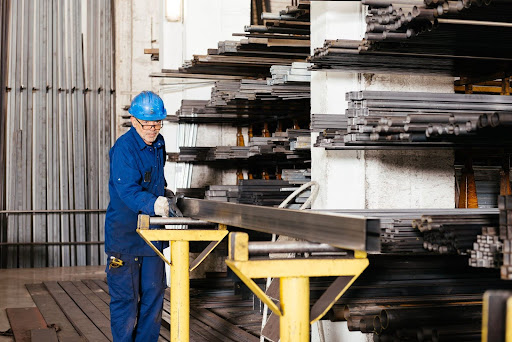
During storage, the material must be kept off the ground. Furthermore, the storage conditions should prevent water accumulation and deformation.
Galvanized parts stored wet and without ventilation can develop whitish stains. This condition occurs when the surface is unable to dry properly.
Paints also require care. Stacking them before they are fully cured can score or remove the coating.
The identification of the parts must remain visible. Swaps during assembly may cause a component to be placed in a different position than intended.
On the construction site, improvised drilling and cutting should be avoided. When authorized, the team must replace the protective barrier.
Lifting should utilize points compatible with the weight and geometry. Deformations can create retention areas or compromise the fit.
Our article about proper storage of steel It provides guidelines for preserving the products before use.
Even the most durable protection systems need inspection. Maintenance identifies faults before corrosion progresses.
Frequency should be adjusted to the harshness of the environment and the importance of the structure. Coastal, industrial, or very humid areas may require more frequent checks.
Visual inspection should look for stains, blisters, peeling, rust, and buildup of debris. Edges and joints deserve special attention.
Pillar bases, areas under gutters, and areas protected from rain also need to be checked. These points can retain moisture for longer.
In addition, we need to check drainage and ventilation. Holes blocked by dirt cease to function.
Minor damage to the coating should be repaired before it spreads. Surface preparation needs to remove corrosion, contaminants, and loose particles.
Repairs should be performed using products compatible with the original system. Inappropriate mixtures may result in poor adhesion or interlayer reactions.
Regular cleaning helps remove salts and pollutants. However, harsh products can damage the coating.
Therefore, the maintenance plan should document methods, materials, and frequency. Photographs and measurements help track progress.
In critical structures, coating thickness tests and section loss assessments can complement visual inspection.
The content about Predictive maintenance in industry It shows how data and inspections support decisions before failures occur.
Life cycle cost considers purchase, manufacturing, installation, maintenance, and replacement. This perspective helps to compare solutions more accurately.
Increasing the thickness raises the weight of the steel from the start. Consequently, transport, lifting, and foundations can also be impacted.
On the other hand, a good coating adds protection primarily to the surface. This solution can extend durability without significant changes in dimensions.
The cost of future interventions needs to be estimated. A low, accessible structure requires simpler maintenance than an operational industrial roof.
Production stoppages are also factored into the calculation. Painting a structure inside a factory may require isolation and interruption of activities.
Furthermore, we need to assess the frequency of interventions. An inexpensive system that requires frequent repairs can lead to higher accumulated costs.
The analysis should use the same period for all alternatives. Comparing only the initial value favors solutions that may not maintain performance.
We also need to consider the possibility of expansion. Standardized and documented systems facilitate replacements and new phases of the project.
Supplier quality influences this outcome. Identified materials that meet specifications reduce risks during execution.
Therefore, the best solution is not necessarily the heaviest or the cheapest. It is the one that meets the load requirements and maintains performance for the expected period.
Planning begins with understanding the environment. We need to identify humidity, salts, pollutants, and potential chemicals.
Next, the design should reduce retention points and facilitate inspection. Drainage and ventilation need to be included in the construction details.
The material must meet the structural specifications. The coating, however, needs to be suitable for the exposure and maintenance available.
Manufacturing and assembly must also preserve the protection. Cuts, welds, and damage need to be treated appropriately.
Before releasing the structure, we recommend verifying the documentation, coating thickness, condition of the connections, and quality of the repairs.
The inspection routine should be defined before the start of operations. This way, maintenance no longer depends solely on the appearance of visible rust.
The page of products from Aço Cearense It offers options for civil construction, structures, metalwork, and industrial applications.
When all these factors work together, we can increase the service life of metal structures without adding unnecessary steel.
Increasing thickness is not a substitute for a durability-oriented design. Coating, environment, manufacturing, and maintenance all need to be part of the same decision.
At Aço Cearense Comercial, we offer steel products for structures, construction, and industrial applications.
Consult our product catalog to learn about materials and options that match your project specifications.
Measurement can be performed using specific instruments, according to applicable technical criteria. In more demanding projects, certificates and inspection reports help to confirm compliance.
Yes, depending on the extent of the damage. The area needs to be cleaned and prepared before applying the recommended system. The repair must be compatible with the existing zinc and paint.
Not always. Moisture stains can appear when wet items are left without ventilation. However, the area should be assessed to determine the extent of the damage.
Yes, when they are exposed to condensation, washing, vapors, or chemicals. The absence of rain does not mean that the environment remains dry.
Blisters, peeling, rust, loss of adhesion, and exposed steel indicate a need for evaluation. Periodic inspections help identify the problem before it progresses.
Yes. The added layer can interfere with holes, threads, and fittings. Therefore, tolerances and connection details need to be considered in the protection process.
 EN
EN  PT_BR
PT_BR