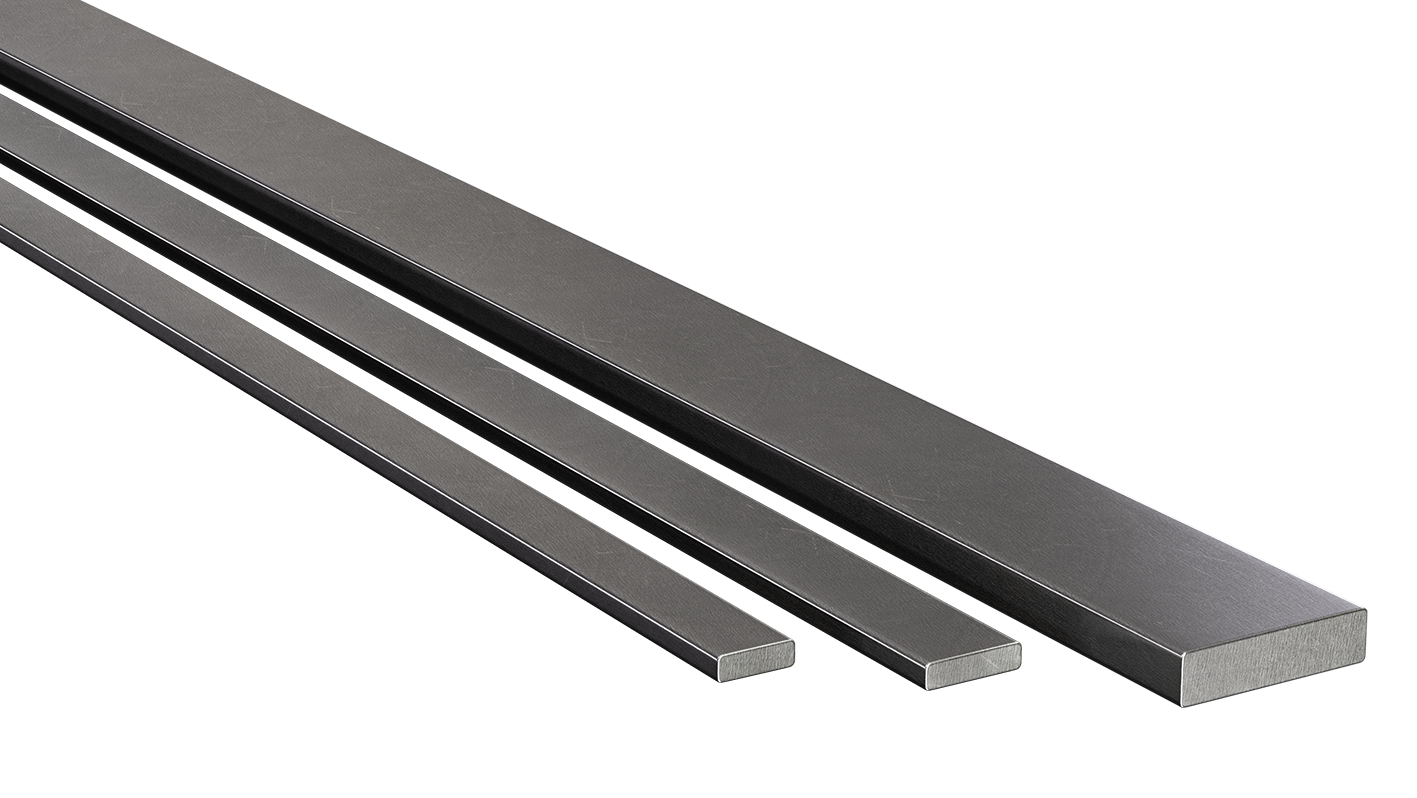
THE flat bar It is a rectangular metal profile suitable for various applications in railings, gates, window and door frames, and metalwork reinforcements. Its flat shape allows for cutting, drilling, bending, and welding, facilitating the manufacture of custom-made parts.
Due to its versatility, the material appears in both residential projects and commercial and industrial structures. However, the choice of width and thickness depends on the stresses the piece will receive, the dimensions of the project, and the installation environment.
Understand where to use flat bars, how to differentiate them from other profiles, and what precautions help avoid mistakes in purchasing and manufacturing.
A flat bar is a solid metal profile with a rectangular cross-section and a width greater than its thickness. The steel industry typically produces this material by rolling, offering different combinations of dimensions.
Unlike tubes, the bar has no internal cavity. Furthermore, its simple shape facilitates the manufacture of crossbars, supports, reinforcements, and decorative elements.
A flat bar measuring 1” x 1/8”, for example, has a width of one inch and a thickness of one-eighth of an inch. This identification helps metalworkers and buyers locate the product specified in the project.
However, dimensions directly affect the behavior of the component. A bar installed with its longest dimension vertically exhibits different bending resistance than the same bar positioned horizontally, considering the same loading direction.
Therefore, the profile's orientation needs to align with the planned efforts.
THE flat steel bar It meets different manufacturing needs, from decorative components to parts that help support and brace structures.
Flat bars combine ease of manufacture and versatility, but their strength depends on their dimensions, orientation, and usage conditions.
Flat bars are frequently found in window guards, walls, staircases, and exterior enclosures.
In these applications, the metalworker can use the profile to form crossbars, uprights, and decorative elements. Furthermore, the material allows for the creation of designs with parallel bars, diagonals, and other geometric patterns.
In gates, flat bars are also used for reinforcements, crossbars, and closing elements. However, the supporting components need to be dimensioned to match the weight and movement of the assembly.
Garage doors, pedestrian gates, and barriers, for example, may require different measurements for structure and finish.
In metal window and door frames, the profile can be used to create moldings, finishes, supports, and fastening details. Its flat surface also facilitates integration with other steel components.
Other applications include:
Each application requires specific measurements and characteristics. Therefore, the choice should consider the intended use, and not just the appearance of the part.
The different ones Types of steel in civil construction They allow you to combine profiles, tubes and sheets according to the needs of each project.
Flat bars facilitate various manufacturing processes. Metalworking shops can cut, drill, bend, and weld the material using equipment compatible with its dimensions and characteristics.
This flexibility allows for the production of both standardized parts and custom-made components.
In residential fences, for example, the professional can repeat cuts and welds to manufacture modules with similar dimensions. In custom gates, the same material is used to create specific designs.
In addition, flat bars can be used in conjunction with pipes, angle bars, and other metal profiles.
In lightweight roofs and pergolas, the product can be used to integrate connections, bracing, and reinforcements. However, it should not automatically replace beams or structural profiles designed for high loads.
When the project requires tubular structures, the steel pipes They offer alternatives with different geometries and mechanical behaviors.
Another precaution involves welding. Heat can cause deformation in long, relatively thin bars, especially when the team concentrates the welding in a single area.
Therefore, the professional must plan the assembly sequence, control the heat input, and verify the alignment of the parts.
In metalworking, flat bars are commonly used as connecting, reinforcing, or finishing elements, depending on the project.
Flat bars and angle bars appear in various metalwork projects. Although both are metal profiles, their geometries have distinct characteristics.
Flat bars have a solid rectangular cross-section, without flanges. Their shape is ideal for flat pieces, crossbars, decorative elements, and certain reinforcements.
The angle bracket has an L-shaped cross-section, with two flanges that form an angle. This geometry allows for the creation of supports, frames, connections, and structures with specific rigidity requirements.
For example, a fence might use flat bars in the vertical elements and angle brackets at support or fixing points.
However, there is no rule that makes one profile always more resistant than another. Performance depends on dimensions, section orientation, and applied forces.
Therefore, the technical manager must assess the expected behavior before defining the material.
THE steel angle bar It can complement flat bars in structures, reinforcements, and fastening systems.
In many projects, the two profiles work together, taking advantage of the characteristics of each geometry.
The choice of dimensions begins with the function of the piece. A decorative railing crossbar faces different stresses than a component that supports part of the weight of a gate.
Width influences bending behavior depending on the bar's orientation. Thickness also affects strength, stiffness, weight, and manufacturing possibilities.
However, these factors need to be evaluated together.
Several criteria can help guide the specification:
A common mistake is selecting rebar based solely on price per meter. After all, a cheaper profile may require later reinforcements if it doesn't meet the project requirements.
Similarly, choosing larger dimensions unnecessarily can increase the weight and cost of the structure.
In certain applications, the Simple U Profile or the Stiffened U-profile It can better meet the requirements for rigidity and geometry.
The best choice takes into account width, thickness, orientation, span, and expected stresses, always according to the function of the piece.
Flat bars have characteristics that favor different transformation processes.
In metalworking shops, four operations are frequently performed: cutting, drilling, bending, and welding.
The professional can use a saw, abrasive disc, or other equipment suitable for the material and the required precision.
In productions with many similar parts, standardized cuts help maintain dimensions and reduce adjustments during assembly.
The pre-drilled holes allow for the installation of screws, latches, hinges, and other components.
However, the design needs to correctly define the diameter and position of the holes. Insufficient distances between the hole and the edge can compromise the strength of the connection.
Bending allows you to create pieces with specific shapes for grids, supports, and decorative elements.
In this case, the radius of curvature must be compatible with the thickness and properties of the steel. Excessively tight bends can cause cracks or unwanted deformations.
Welding joins flat bars to pipes, sheets, angle bars, and other metal parts.
To achieve a suitable result, the team needs to control surface preparation, welding parameters, and the execution sequence.
In addition, long, thin bars require attention to heat to prevent warping.
Planning for cutting and bending of steel sheets It presents criteria that also help to understand the importance of material sizing and utilization in transformation processes.
Exterior fences, gates, and window frames are exposed to rain, humidity, and temperature changes.
In coastal regions, sea air also increases the aggressiveness of the environment. Therefore, carbon steel structures need surface protection compatible with the location.
Painting is one of the most commonly used alternatives. It creates a barrier between the steel and external agents, provided that the preparation and application follow the specifications of the chosen system.
Another option involves galvanizing. The zinc coating helps protect the base steel and can reduce the progression of corrosion under certain conditions.
THE galvanized steel It serves different outdoor applications, according to the product specification and the exposure environment.
However, cuts, holes, and welds made after the coating has been applied can compromise protective points. These areas may require additional treatment.
The design of the structure also affects its durability.
Gates and fences that accumulate water in cracks or crevices tend to have more vulnerable areas. Similarly, parts in direct contact with damp soil require special attention.
In addition, maintenance should include regular cleaning and inspection. Minor damage to the coating can worsen if left unrepaired.
Understanding the mechanisms of corrosion of steel It helps to define preventive measures from the design stage.
Corrosion protection should be part of the initial specification, especially for parts intended for outdoor environments.
One of the most common mistakes is choosing a flat bar based solely on appearance or price.
Although two parts may have a similar shape, differences in width and thickness alter their behavior under load.
Another problem arises when the design ignores the orientation of the bar. A piece positioned with its wide face horizontally behaves differently from the same bar installed at a corner, depending on the direction of the stress.
Cuts that are not square and have burrs also hinder assembly. In addition to making fitting difficult, they can compromise the quality of the welds.
Heat concentration during manufacturing presents another risk. Extensive welding on thin bars can cause warping and require subsequent corrections.
It's also important to avoid buying a single size for all parts of the project. After all, structural and decorative components don't always need to be the same size.
In outdoor applications, the absence of corrosion protection can lead to premature repairs and replacements.
Therefore, each component must follow the specification corresponding to its function.
The planning of purchase of steel for industrial works and projects It helps to organize measurements, quantities, deadlines, and processing needs.
The specification of the flat bar begins with identifying the parts that will form the assembly.
In a grid, for example, the design can bring together crossbars, uprights, moldings, and decorative elements. Each component needs dimensions compatible with its function.
The next step is to check the gaps and attachment points. This information helps determine the lengths and position of the parts.
In addition, the team needs to consider the necessary clearances for hinges, rails, and other mechanisms.
Measurements taken before installing door frames or completing masonry work may require adjustments, especially when the actual opening differs from the initial design.
The choice should also take the environment into consideration. Exterior gates may require painting, galvanizing, or other protective systems, depending on the exposure conditions.
Another factor is the volume of production.
Projects with many similar grades can benefit from standardizing measurements and cutting processes. Conversely, unique pieces may require greater flexibility during manufacturing.
Before purchasing, the buyer should gather the width, thickness, length, quantity, and finishing requirements.
A complete specification reduces uncertainty during manufacturing and helps prevent material waste.
In lightweight structures, flat bars can function as connecting, reinforcing, and bracing elements.
Metal pergolas, supports, bases, and certain enclosure structures can utilize this profile in conjunction with tubes and angle brackets.
However, the choice depends on the distribution of efforts.
A beam that functions well as a crossbeam may not have sufficient rigidity to act as the main beam for a larger span.
Therefore, the team should not replace other profiles without evaluating the structural consequences.
Connections also require attention. Holes near the edges, inadequate welds, and insufficient support points can compromise performance.
In addition, external structures need to take into account wind, rain, and corrosion protection.
You structural steel profiles They feature different geometries that help meet connection, support, and structural needs.
Flat bars can complement lightweight structures, but the design must define their function and dimensions based on the anticipated stresses.
The choice of supplier should consider the availability of sizes, the quality of the material, and compliance with project specifications.
Before requesting a quote, the buyer needs to gather the width, thickness, length, and quantity.
It is also advisable to specify the intended use of the product. A purchase for decorative railings may have different needs than those of an industrial project with parts subject to loads.
Furthermore, the delivery timeframe must align with the manufacturing or installation schedule.
At Aço Cearense Comercial, we distribute flat bars in different widths and thicknesses for applications in metalworking, construction, and industry.
Our sales team can advise you on the available options and provide the necessary information for a quote.
Flat bars are suitable for a variety of projects, from decorative elements to reinforcements and components of metal structures.
However, the result depends on the correct choice of dimensions, processing, and surface protection.
At Aço Cearense Comercial, we distribute steel products to metalworking shops, manufacturers, construction companies, and industries.
To view the available options, Download our product catalog.. With the measurements defined, consult our online store or request a quote with our sales team.
A flat bar has a solid rectangular cross-section. An angle bar, on the other hand, has an L-shaped cross-section with two flanges. These geometries exhibit different behaviors depending on their dimensions, orientation, and the applied forces.
Yes, provided the design takes into account the function of the component, the loads, and the installation conditions. Additionally, outdoor environments may require painting, galvanizing, or other corrosion protection.
The choice depends on the span, the function of the component, the expected stresses, and the fastening conditions. Therefore, the person responsible for the project must evaluate these factors before defining the dimensions.
Yes. Flat bars allow for different welding processes, depending on the steel composition and manufacturing conditions. However, the team needs to control the heat to avoid deformation.
Yes. Metalworking shops and manufacturers can perform the cutting according to the project dimensions. In productions with many pieces, standardization helps reduce errors and waste.
It depends on the dimensions, orientation, span, and anticipated stresses. Although it can be integrated into structures and reinforcements, the material does not automatically replace profiles designed for high loads.
The industry produces rolled flat bars directly in the desired section. Cut sheet metal bars, on the other hand, result from a cutting process that can generate different edge and finish characteristics.