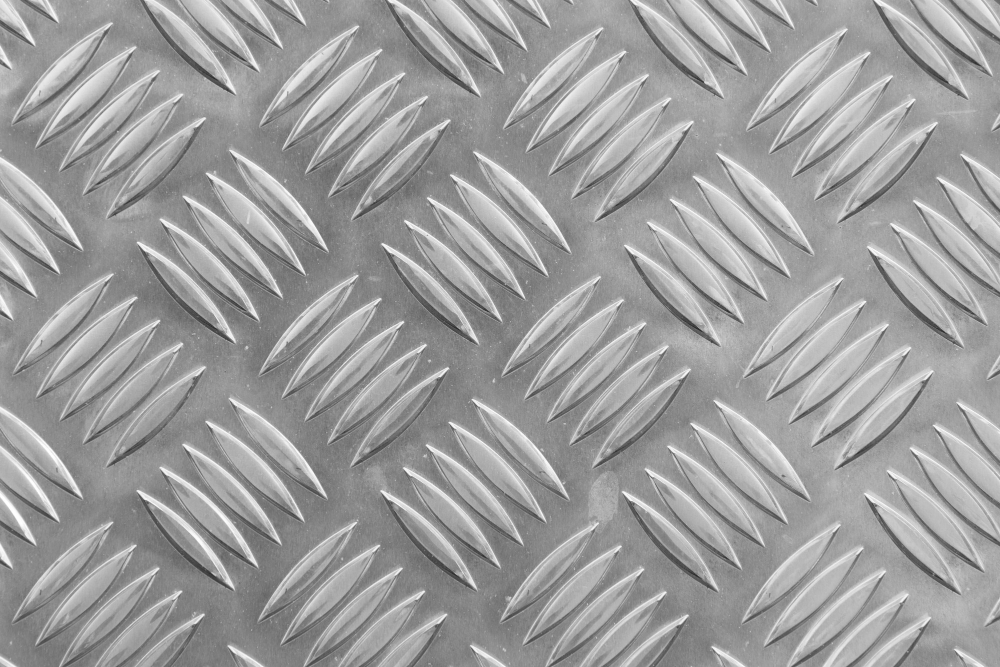
THE checkered plate It is a steel sheet that features a diamond-shaped relief on one side. This design characterizes the material and favors its use in industrial floors, metal platforms, steps, ramps, and circulation areas that require greater grip.
The other side remains smooth, which facilitates certain forms of support and fastening in metal structures. This combination differentiates checkered plate from a conventional plate, especially in applications that need to combine strength and safety for circulation.
In this article, we explain how the manufacturing process works, why embossing improves grip, what the main applications are, and what to consider before choosing thickness, shape, and surface protection.
Checker plate is a steel product that features a diamond-shaped relief pattern on its surface. During rolling, cylinders with specific designs imprint this shape onto the steel.
The process creates a texture that helps improve grip during movement. Therefore, the material is used in floors, platforms, ramps, stairs, and areas near industrial equipment.
In technical catalogs, the product may also be referred to as checkered flooring or non-slip metal flooring. Although the nomenclature varies, the main characteristic remains the same: a metallic surface with raised patterns that promote contact with footwear and wheels.
Compared to smooth sheet metal, checkered sheet metal offers a texture that is more suitable for certain walkways. However, the raised pattern does not completely eliminate the risk of slipping, especially when there is oil, grease, or other accumulated residue.
Thus, the central function of the material is to offer a metallic surface with greater grip., provided that the project also considers load, maintenance, and conditions of use.
The manufacturing process begins with heating the steel, which is then rolled until it reaches the desired dimensions and thickness.
During this process, one of the cylinders displays a rhomboid pattern. Upon contact with the material, the equipment imprints the characteristic relief of the checkered plate.
In this way, the industry creates the texture during the steel processing itself, without needing to add a non-slip layer later.
After lamination, the material goes through cooling, finishing, and preparation stages for commercialization, according to the characteristics of the industrial process.
At Sinobras, we produce steel at our plant in Marabá, Pará, strengthening our presence in the steel industry and serving the markets of the North and Northeast regions.
For applications that require specific dimensions, the cutting and bending of steel sheets It can be integrated into the transformation process, depending on service availability and project needs.
This planning allows for the reduction of material waste and better organization of the manufacturing of parts for different applications.
The rhomboid relief creates raised points of contact between the sheet metal and the surfaces that pass over it, such as footwear and equipment wheels.
On a smooth sheet, water, oil, or dust can form a continuous layer, increasing the risk of slipping. The checkered pattern of the sheet modifies this surface and can improve grip under certain conditions.
This characteristic explains its presence in industrial platforms, walkways, metal staircases, and ramps.
However, grip also depends on maintenance. The accumulation of grease between the diamond shapes can compromise the anti-slip function of the material.
Furthermore, the wear and tear caused by heavy traffic can reduce the height of the terrain and alter the contact conditions.
For this reason, checkered plate should be integrated into a set of safety measures that includes cleaning, signage, lighting, securing, and maintenance.
The non-slip design improves circulation conditions, but it does not replace other necessary precautions for a safe environment.
Checker plate combines mechanical strength, a textured surface, and the possibility of industrial transformation.
Depending on the characteristics of the steel, the dimensions, and the design, manufacturers may perform cuts, holes, welds, and other processes to adapt the material.
Another feature is the variety of thicknesses available on the market. This diversity allows it to meet different needs, from areas with pedestrian traffic to platforms subject to higher loads.
However, The thickness of the sheet metal alone does not determine its load-bearing capacity.. The support structure, spans, and method of attachment also affect performance.
The installation environment deserves similar attention. In outdoor areas, moisture can accelerate the corrosion of unprotected carbon steel.
Therefore, the project needs to consider the use of paint, galvanizing, or other treatments compatible with the exposure.
The choice should also take into account the edge finish and ease of cleaning, especially in industrial areas with constant traffic.
The main difference between checkered plate and flat plate is in the surface pattern.
Flat sheet metal has flat surfaces and is suitable for applications such as enclosures, cladding, industrial parts, and components that do not require a non-slip surface.
Checker plate, on the other hand, has diamonds on one side, a characteristic that favors its use in areas intended for circulation.
For example, a maintenance platform may require a surface with greater grip. On the other hand, a closing panel may use a smooth sheet when the design does not require this function.
Maintenance also presents differences. While the smooth surface usually facilitates the removal of certain residues, the raised patterns of the checkered plate require attention to the spaces between the diamonds.
Therefore, the choice needs to consider the function of the piece, and not just its appearance.
The different ones Types of steel in civil construction They meet specific needs in terms of strength, finish, and application.
The main difference between checkered plate and checkered coil lies in the delivery format.
The coil features the material rolled up, allowing industries and processors to define lengths during processing.
This format is usually of interest to operations with high production volumes, especially when the equipment allows for direct handling of coils.
Checker plate comes in sheets with commercial dimensions, which can facilitate its use in metalworking shops, construction sites, and by manufacturers of metal parts.
Therefore, the decision depends on the required volume, processing capacity, and the measures outlined in the project.
Companies that manufacture many similar parts can evaluate the use of coils. Conversely, specific applications may favor the purchase of sheets.
Furthermore, the transportation, storage, and handling of the material need to be taken into consideration in the comparison.
The supply format should match the buyer's production structure and the quantity of parts required.
Checker plate appears in different segments, mainly when the project requires a metallic surface for circulation.
In civil construction, the material can be used to form walkway floors, mezzanines, metal staircases, landings, and technical access points.
In industrial settings, it serves operating platforms, walkways near equipment, and maintenance areas.
In transportation and logistics, manufacturers also use embossed sheets on truck bodies, ramps, and loading and unloading platforms.
In commercial establishments, checkered sheet metal can appear in service entrances, steps, technical areas, and environments that receive frequent traffic.
Furthermore, the material can be integrated into metal structures that require durable surfaces and ease of assembly.
In all these cases, the specification depends on the expected loads, the distance between supports, and the exposure conditions.
You structural steel profiles They can form the structures responsible for supporting these surfaces.
Therefore, checker plate is suitable for construction, industry, and logistics, provided the project takes into account the overall functionality of the system.
Thickness affects the bending strength, weight, and ability of the sheet to withstand the conditions specified in the design.
The Brazilian market works with different thicknesses, including measurements such as 2.65 mm, 3.00 mm, and 4.75 mm, depending on the manufacturer and product line.
However, these measures do not automatically correspond to specific applications.
A thinner sheet of metal may be suitable for a given circulation area when the structure has nearby supports and compatible loads. However, the same sheet may not work in larger spans.
Similarly, industrial platforms may require thicker plates or lower structures with greater load-bearing capacity.
Therefore, the technical manager must evaluate:
The correct thickness depends on the structural design and the actual conditions of use, not just the type of environment.
The checkered plate acts as a circulation surface, but depends on the underlying structure to support the loads.
In walkways and platforms, beams, angle bars, tubes, and profiles can make up this support system.
The design needs to consider the distance between the structural elements. After all, larger spans increase the demands on the sheet metal and its supports.
In mezzanines, for example, the sheet metal can form the metal floor over a main structure. In this case, the calculation must take into account people, equipment, and stored materials.
Furthermore, the fastening must prevent displacement. Loose plates can cause noise, vibrations, and tripping hazards.
To the steel angles and the steel pipes They can incorporate specific support structures, according to the project requirements.
Therefore, the choice of sheet metal should occur along with the sizing of the structure that will support the material.
Ramps and stairs pose significant risks of slipping, tripping, and impact. Therefore, they require special attention to their design and installation.
On ramps, the checkered plate pattern can improve grip. However, the slope must respect the usage conditions and applicable technical requirements.
The movement of people transporting materials, carts, or equipment requires specific evaluation.
On stairs, the sheet metal must remain firmly in place on the steps. Loose edges, burrs, and unevenness can increase the risk of accidents.
In addition, the project must include usable width, step height, handrails, and other safety features.
In outdoor areas, rain, dust, and temperature changes increase the need for inspection.
The maintenance team needs to regularly check the fasteners, the wear on the surface, and the presence of corrosion.
Therefore, The performance of checker plate also depends on the inclination, the support structure, and the installation conditions..
Carbon steel checker plate can oxidize when left exposed to rain, moisture, or sea air without adequate protection.
Therefore, external applications require careful consideration from the specification stage onwards.
Industrial painting is one of the alternatives. It creates a protective barrier on the surface, provided that the preparation and application follow the requirements of the chosen system.
Another possibility involves the use of zinc coatings, depending on the product characteristics and the feasibility of the process.
THE galvanized steel It offers corrosion protection provided by the zinc coating, although its suitability depends on the exposure conditions.
Cuts, holes, and welds also deserve attention. These operations can expose the base steel or compromise existing coatings.
Furthermore, the design of the piece affects its preservation. Areas that accumulate water, dust, and debris tend to present a greater risk of wear and tear.
In locations subject to sea air or constant humidity, understanding the mechanisms of corrosion of steel It helps define the necessary protective and maintenance care.
Checker plate requires periodic maintenance because the raised pattern, which promotes grip, can also accumulate dirt, oil, and grease.
In many applications, cleaning with water and neutral detergent helps remove common residues, provided the procedure is compatible with the coating and the manufacturer's instructions.
In industrial settings, the team may need specific products and tools to remove residue from the grooves.
Frequency depends on the operation. Areas with oil, fine dust, or heavy traffic require more regular inspections.
In addition to cleaning, it is necessary to check welds, cut edges, and fastening points.
Painted panels require special care in the raised areas, which are subject to constant friction. When the paint shows wear, repairs to the coating may be necessary.
Therefore, maintenance should not only consider appearance. It needs to assess adhesion, corrosion, fastening, and structural stability.
One of the most common mistakes is choosing checkered sheet metal solely based on the appearance of the embossed pattern.
Although the anti-slip design is important, it alone does not define the load capacity.
Another problem arises when the buyer ignores the distance between the supports. A sheet suitable for small spans may exhibit deformations in larger structures.
There are also risks associated with outdoor applications without corrosion protection. Rain, sea air, and constant humidity require precautions that should begin in the design phase.
Poorly finished cuts and inadequate welds create burrs, gaps, and vulnerable points.
In circulation areas, the installation must avoid unevenness and displacement of the sheet metal.
Finally, projects with many parts require attention to quantities, measurements, and deadlines.
THE steel purchase planning It helps organize specifications, volumes, delivery stages, and material verification.
The correct choice requires compatibility between thickness, load, span, surface protection, and support structure.
The purchase should begin with considering the function of the piece. Will the project use the checkered plate as flooring, a ramp, a step, a platform, a vehicle body, or a circulation surface?
Next, the buyer needs to check the thickness, dimensions, quantity, type of cut, and method of attachment.
Environmental characteristics also factor into this assessment. Water, oil, dust, and corrosive agents may require additional precautions.
To organize your order, gather the following information:
With this data, the supplier can prepare a quote that is more aligned with the characteristics of the application.
At Aço Cearense Comercial, we distribute steel sheets and other steel products to construction sites, industries, metalworking shops, and manufacturers.
After learning about the characteristics of checker plate, its applications, and specification considerations, the next step is to compare dimensions and available options.
At Aço Cearense Comercial, we bring together steel products for construction, industry, and circulation structures.
To view the specifications, Download our product catalog.. With the measures defined, it is also possible to consult the Aço Cearense online store or Request a quote from our team..
No. The diamond-shaped relief helps improve grip compared to certain smooth surfaces. However, oil, grease, accumulated dirt, and wear can compromise this characteristic. Cleaning and maintenance are still necessary.
The main difference lies in the delivery format. The coil arrives rolled up and is suitable for operations that have processing equipment. The sheet, on the other hand, arrives in sheets, which facilitates its use in different projects.
The choice depends on the expected load, the distance between supports, and the underlying structure. Therefore, the responsible technician must evaluate these factors before determining the sheet thickness.
Yes. Carbon steel checker plate can corrode when exposed to moisture without proper protection. Painting and other surface treatments can help reduce this risk.
Yes, provided the chosen process is compatible with the material and application. Surface preparation and edge protection deserve special attention.
Smooth sheet metal has flat surfaces. Checker plate, on the other hand, has a raised texture on one side, a characteristic that makes it ideal for use in floors, ramps, steps, and platforms.
Yes, provided the project includes corrosion protection, drainage, and maintenance. In areas with frequent rain or sea air, these precautions require even greater attention.