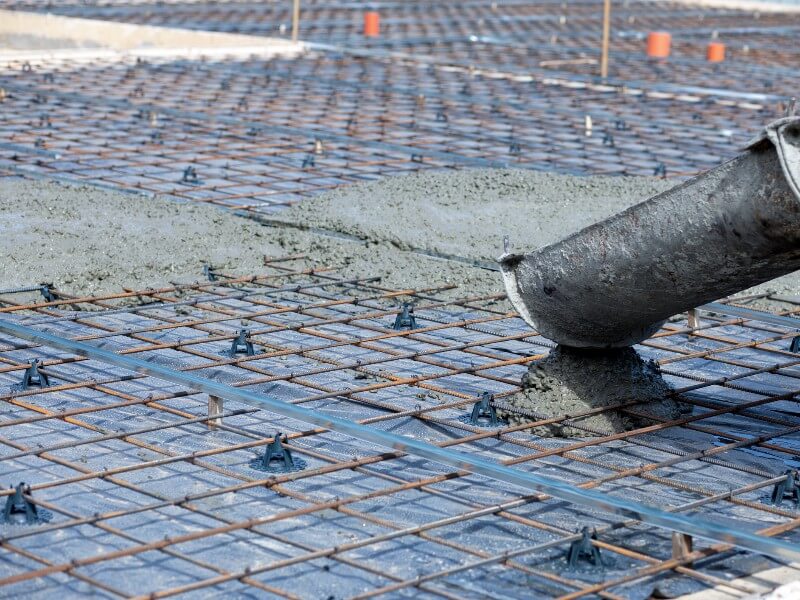
THE CA-50 and CA-60 rebar It reinforces reinforced concrete elements, but each category has specific properties and applications. CA-50 is frequently used in main reinforcement. CA-60 is common in stirrups, mesh, trusses, and other components defined by the project.
The numbers 50 and 60 indicate distinct classes of steel strength. However, one class should not replace another simply because it has a higher value. Ductility, diameter, adhesion to concrete, and structural function also guide the choice.
Therefore, the buyer must follow the engineering specifications. Correctly reading the project avoids unnecessary replacements, waste during cutting, and delays on the construction site.
Reinforcing bars are steel bars or wires used to form reinforcement in concrete structures. They help the structure withstand stresses that concrete alone cannot absorb with the same efficiency.
Concrete exhibits good compressive strength. However, its tensile strength is more limited. Steel reinforcement absorbs some of these stresses in beams, columns, slabs, foundations, and other structural elements.
The CA-50 and CA-60 categories follow requirements defined by ABNT NBR 7480:2024. This standard addresses identification, mechanical properties, dimensions, surface finish, and supply conditions.
The abbreviation CA indicates the use of steel in reinforced concrete structures. The numbers differentiate the yield strength classes.
THE CA-50 It has a characteristic yield strength of 500 MPa. CA-60 It has a characteristic strength of 600 MPa.
This difference alone does not determine where each material will be applied. Structural calculations also consider deformation capacity, reinforcement geometry, adhesion, and component detailing.
The main difference lies in the strength class. CA-60 withstands a higher characteristic yield strength than CA-50.
This doesn't mean it's the automatic choice for any element. Engineering needs to analyze how the steel will behave within the concrete and what deformations will be required.
CA-50 features a combination that favors its use in main reinforcement. It is found in ribbed bars, whose surface helps transmit forces between steel and concrete.
CA-60 steel is commonly found in smaller diameters and in components such as stirrups, mesh, and trusses. Its use can also extend to other applications, provided its properties have been considered in the design.
The main differences can be summarized as follows:
The content about Types and applications of rebar. It presents other characteristics of these categories.
The ribs are raised areas distributed along the surface of the rebar. They create a mechanical bond between the steel and the hardened concrete.
This connection allows for the transfer of forces between the two materials. Without proper adhesion, the bar could slip inside the structural element.
The surface geometry must follow the normative criteria. The height, spacing, and inclination of the ribs affect the contact between the reinforcement and the concrete.
In CA-50, the ribbed surface is a distinctive feature. It helps the steel work together with the concrete in key elements.
CA-60 may also have a ribbed surface, depending on the product and the requirements of the standard. Therefore, identification should not be based solely on appearance.
The article about smooth and ribbed reinforcing bars It explains how the surface affects the application.
Adhesion still depends on the execution. Poorly compacted concrete, incorrect bar positioning, and insufficient cover impair the functioning of the reinforcement, even when the steel meets the technical requirements.
CA-50 is frequently found in the main reinforcement of reinforced concrete structures. These bars are subjected to tensile, bending, and other stresses specified in the calculations.
In beams, the material can form upper and lower longitudinal reinforcement. The position and quantity vary according to the span, supports, and loads.
In columns, longitudinal bars help resist the forces transmitted from the floors. Stirrups surround these bars and aid in confining the assembly.
In slabs, CA-50 can be used in the directions indicated by the project. The arrangement depends on the construction system and the load distribution.
Foundations also utilize this material. Footings, blocks, foundation beams, raft foundations, and piles can incorporate bars of different diameters and shapes.
CA-50 is still found in reservoirs, retaining walls, bridges, pavements, and precast elements. However, no application should be defined by a generic rule.
The person in charge of the project determines the class, gauge, position, and quantity. To better understand this relationship, see our content on... steel and concrete It explains how the materials work together.
CA-60 is frequently found in components manufactured with smaller diameter wires. Stirrups, welded wire mesh, trusses, and prefabricated reinforcements are among the well-known examples.
In stirrups, steel surrounds the longitudinal bars of beams and columns. These elements help maintain the position of the bars and contribute to resisting transverse forces.
THE stirrup in civil construction It is necessary to respect the diameter, spacing, bends, and anchorages defined in the detailing.
Welded wire mesh uses wires joined at regular points. It can be applied to floors, slabs, pavements, and prefabricated components, according to specifications.
Trusses also combine wires in a standardized geometry. They appear in precast slabs and other construction systems.
CA-60 should not be described merely as steel for secondary functions. Its use results from structural calculations and detailing.
The higher resistance does not authorize reducing gauges, spacing, or quantities directly on the construction site. Any alteration must be analyzed by the responsible technician.
Yes. The same structure can use CA-50 and CA-60 in different functions. This combination is common when the design specifies main bars and transverse reinforcement with different categories.
A beam can be reinforced with CA-50 steel in the longitudinal bars and CA-60 steel in the stirrups. A slab can combine bars with mesh or trusses depending on the solution adopted.
Using them together does not mean that the products can be mixed during assembly. Each item must remain in the position indicated in the drawings.
The team should separate the materials by category, gauge, and stage of the work. Visible identification reduces the risk of mix-ups during cutting and reinforcement.
It is also necessary to check the steel lists. The codes used in the project must match the markings present in the plans and details.
When CA-50 and CA-60 appear in the same component, even more rigorous control is required. A substitution can alter strength, deformation, and anchoring conditions.
The purchasing team must accurately reproduce the project description in the order. Generic expressions, such as "reinforcing steel for columns," do not specify category, diameter, or quantity.
The gauge corresponds to the nominal diameter of the reinforcing bar. It influences the steel area, weight per meter, load-bearing capacity, bending capacity, and space occupied within the reinforcement.
Smaller diameters are common in stirrups, screens, and lightweight components. Larger gauges appear in elements that require larger steel areas.
However, there is no mandatory gauge for all columns, beams, or slabs. The design defines the diameters according to loads, dimensions, and bar arrangement.
Changing between gauges requires recalculation. Replacing several smaller bars with a few larger ones alters spacing, adhesion, cracking, and assembly.
The buyer also needs to consider the delivery method. The material may arrive in straight bars, rolls, or folded configurations, depending on the category and product.
In our online store, Customers in Ceará can browse available options and check commercial measurements before purchasing.
The quotation should include the category, diameter, length, quantity, and delivery method. This description reduces confusion between engineering, purchasing, the supplier, and the construction site.
A steel bill of materials transforms structural drawings into information for cutting, bending, and purchasing. It typically includes the position, diameter, quantity, unit length, and total length.
Before drafting the request, the team must confirm the project review. An old list may contain measurements that have already been changed by engineering.
Barcodes need to be compared with the drawings. The same position must maintain class, format, and dimensions in all documents.
We should also check the units. Lengths may be given in centimeters, millimeters, or meters, depending on the standard used.
The weight should not be estimated solely by the number of bars. It depends on the diameter and total length of each item.
When in doubt, the purchase should await technical clarification. Adjusting a measurement based on previous experience may result in incompatible material.
Our content about How to avoid waste with technical support. This shows how more precise descriptions reduce rework.
The list still needs to be aligned with the schedule. Buying the entire volume at once can take up excessive space on the construction site and make organization difficult.
Planning begins with determining the quantities specified in the project. Then, the team must organize the order according to the execution phases.
Foundations, pillars, beams, and slabs can be delivered separately. This division reduces handling and facilitates batch verification.
The cutting plan also affects consumption. Commercial bars need to be used to produce pieces with the least possible amount of leftover material.
The team should not add loss percentages without analyzing the project. Formats, lengths, and reuse capacity vary between projects.
Leftover pieces of material should not be used in any position simply because they are of similar length. Splices and anchorages must follow the structural details.
Another important aspect involves the cutting and folding process. When the prepared pieces arrive, the inspection team must compare labels, positions, and quantities against the list.
Our article about steel cutting and bending It shows how this planning interferes with execution.
An organized purchase considers quantity, sequence of use, storage capacity, and delivery time.
The lowest price per ton may mask differences in origin, documentation, dimensional consistency, and commercial support.
Reinforcing bars intended for reinforced concrete must meet applicable technical requirements. Compliance involves mechanical properties, mass, dimensions, and surface characteristics.
Non-standard products can affect quantities and execution. A variation in mass, for example, alters the actual volume of steel received.
Delivery also affects the cost. Delays can disrupt framing and concreting, mobilizing teams without available materials.
Another expense arises from exchanges and returns. An incorrectly shipped gauge requires sorting, transportation, and a review of the schedule.
Therefore, the buyer should analyze price, origin, certification, availability, and delivery time all within the same process.
At Grupo Aço Cearense, we integrate production and distribution. At Sinobras, we produce CA-50 and CA-60 bars and wires. At Aço Cearense Comercial, we distribute steel products to different types of projects and clients.
This structure makes it possible to connect the origin of the steel to the needs of purchasing and supply.
THE ABNT NBR 7480:2024 It establishes the requirements for bars and wires intended for reinforced concrete structures. It addresses categories, identification, mechanical properties, and supply conditions.
Furthermore, steel bars and wires intended for reinforcement are subject to conformity assessment by Inmetro. This control aims to verify characteristics related to product safety.
When purchasing, verify the supplier's certificates and documentation. Manufacturer identification, category, batch number, and diameter help maintain traceability.
On our page Quality Management System, We provide information about CA-50 and CA-60 certifications.
At Sinobras, we manufacture bars and wires in accordance with the requirements of ABNT NBR 7480:2024. Our management system is also ISO 9001:2015 certified within the scope disclosed for these products.
Certification, however, does not eliminate the need for on-site inspection. The order, documents, and materials received must all contain consistent information.
Any discrepancies must be recorded before cutting, bending, or assembling the reinforcement.
The verification process should begin before unloading. The invoice, purchase order, and bill of materials must indicate the same categories and sizes.
Next, the team must verify the identification, quantity, length, and overall condition. Mixtures between CA-50 and CA-60 can cause errors in subsequent steps.
The markings on the bars help identify the manufacturer, category, and diameter, according to applicable criteria. Labels and ties also organize the batches.
Several points deserve attention:
The inspection should take place in a safe location with appropriate instruments. If there is any doubt about the diameter or mass, the responsible technician may request additional verifications.
Divergent material should not be mixed with approved stock. Separation prevents it from being used before analysis.
Reinforcing bars should be separated by category, gauge, and stage of use. This organization reduces errors and speeds up the supply of materials to the work sites.
The poles should not rest directly on the ground. Platforms or supports prevent contact with mud, standing water, and contaminants.
The location must allow for drainage and circulation. Temporary coverings should not trap moisture against the steel.
Labels must remain legible. If the original identification is lost, staff should discontinue use until the material is confirmed.
Long bars require distributed supports. Improper storage can cause warping and make assembly difficult.
We must also control the movement of machinery and equipment. Impacts, twisting, and dragging damage the condition of the bars.
Our guide on steel storage It provides guidelines for organizing inventory and preserving products.
Planning deliveries reduces the time spent on the construction site. In this way, the project avoids inventory exceeding its capacity to manage.
The cut must respect the lengths indicated in the steel list. Small differences can compromise anchorages, splices, and concrete cover.
The bending process must also adhere to the specified shapes and diameters. Inappropriate radii or poorly adjusted equipment can damage the bar.
Steel should not be heated on-site to facilitate bending without a technical specification. Heat can alter the material's properties.
Bars that have already been bent should not undergo successive corrections without evaluation. Bending and unfolding the same section creates concentrated deformations.
The team needs to separate the parts by position after processing. Labels should indicate the code, quantity, and application location.
When cutting and bending services are contracted out, the files sent to the supplier must correspond to the current revision of the project.
Changes made after production can result in unusable parts. Therefore, release should only occur after engineering validation.
Organizing the reinforcement plant also reduces mixing. CA-50 and CA-60 should follow identified flows during processing and assembly.
The correct rebar is the one specified in the structural design. Category, gauge, quantity, length, and position form a single specification.
The buyer should not select CA-50 or CA-60 based solely on the structural element. Two columns may have different reinforcement due to loads and dimensions.
The same applies to stirrups and screens. Although CA-60 is frequently used in these applications, the detailed specification remains the benchmark.
The purchase must include complete descriptions. It should also specify the delivery time, method of delivery, and storage conditions.
Before finalizing, we recommend checking five points: project review, steel list, category, gauge, and quantity.
When any data is missing, the responsible technician must complete the information. Suppliers and buyers should not redesign the reinforcement on their own.
In the product page of the Aço Cearense Group, We offer options for civil construction, structures, metalwork, and industry.
With clear specifications, the quote becomes more accurate and the team reduces the risk of receiving materials different from those calculated.
The choice between CA-50 and CA-60 begins in the design phase and continues throughout the purchasing process. Documentation, identification, deadlines, and delivery conditions must align with the technical specifications.
At Sinobras, we produce steel bars and wires for reinforced concrete structures. At Aço Cearense Comercial, we connect this portfolio to the demands of construction companies, distributors, and construction professionals.
Check the available options and Download our catalog. to compare products intended for different stages of construction.
Not without analysis by the responsible technician. The difference in resistance is not the only criterion. Ductility, adhesion, diameter, anchorage, and function of the reinforcement also influence the calculation.
Barcode markings can aid in identification. However, we do not recommend using material without confirmed traceability. The batch number must be linked to the supplier and receiving documents.
Slight surface oxidation does not allow for a conclusion in isolation. The responsible technician must assess section loss, adhesion, flaking, and contamination before releasing the material.
Welding depends on the steel specification, the design, and the approved procedure. It should not be performed solely to replace fastenings or correct incompatibilities.
No. The length, position, and type of splice are defined by the design. Alterations may impair the transfer of forces between the bars.
They can remain in the same stock, provided they are clearly separated and identified. The organization must prevent mix-ups during cutting, bending, and assembly.