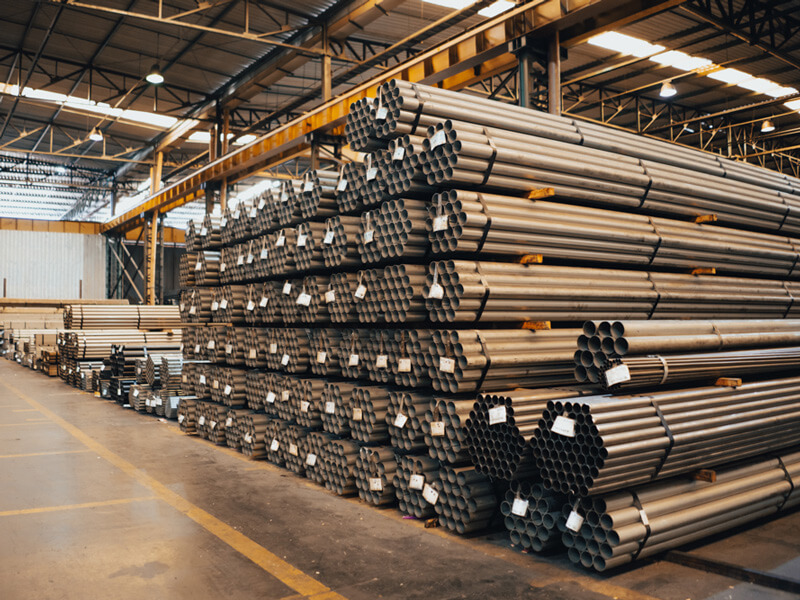
Buildings, bridges, measuring instruments, vehicles, and many other products are produced with the help of the steel industry, which produces steel and other ferrous materials. So, do you see how important this sector is?
In this scenario, Brazil is fortunate to have an abundance of natural resources and a strategic geographic location, close to important markets, such as the United States and other European countries.
Want to learn more about the steel industry, what it produces, how it works, and other relevant information? Keep reading to stay up to date!
As we've seen, this segment is responsible for manufacturing products from steel and other ferrous materials essential to economic growth. This process involves several steps, including:
Brazil's natural characteristics favor the development of steel mills. This contributes to making the country the ninth among the world's largest steel producers, according to the Brazilian Association of Metallurgy, Materials and Mining.
This is relevant data, as this type of production moves the economy by providing inputs for various segments, such as:
All of this makes the sector very relevant to the Brazilian economy, having produced 30.2 million tons in 2020, even with the Covid-19 pandemic. Therefore, during this period, steel industry generated R$39.9 billion in the country, according to the Brazilian Steel Institute.
The economic activity provided by the sector is also positive for the Gross Domestic Product (GDP) by directly and indirectly employing thousands of people. For greater accuracy, there are 100,000 direct jobs throughout Latin America, such as engineers, welders, electricians, logistics operators, technicians, etc. The data is from the Latin American Steel Association (Alacero).
The steel production chain also generates 2 million indirect jobs. These jobs can be created by other companies that supply raw materials, by sectors that use this material to manufacture other products, and much more. Many of these jobs involve professionals in mining, transportation, equipment manufacturing, and maintenance and repair services.
Despite steel production's significant contribution to the economy, the industry is currently facing challenges and uncertainties, which are explained by a number of factors. Learn about the main ones below!
The decrease in global demand for steel was greatly influenced by the economic crisis caused by Covid-19 pandemic, which began in late 2020. As a result, many sectors that use this material, such as the construction and energy industries, suffered financial losses and slowed production. This was mainly due to the shutdown of various economic activities in different countries.
Furthermore, even with the resumption of production, economic instability in many countries and uncertainty about the future impacted decision-making. This is because the safest option for many businesses was to postpone investments in expansion projects to build a larger financial reserve and contain expenses.
In recent years, more steel producers, including those from emerging countries, have entered the market, putting pressure on prices and reducing steel companies' profit margins. Among the new entrants to the sector, Brazil is already positioned as one of the largest in the world, alongside Turkey and Indonesia—other emerging countries that have also stood out.
In this scenario, each company seeks to offer more competitive prices to customers to gain market share, which increases competition in the sector. Pricing is also influenced by fluctuations in the value of raw materials, such as iron ore, which is used in steel production. This increases production costs and, consequently, the final price of the product.
Despite the reported challenges, global steel production recorded a rise in 2022, of 3.7% in September, signaling a positive outlook. The countries that most influenced these results were China, India, and Iran, respectively. The data is from the World Steel Association.
However, for the forecast to remain optimistic, it's necessary to consider a series of factors for the coming years, such as trends and challenges. Among them:
The conflict between Russia and Ukraine severely impacts the Donetsk and Luhansk regions, located in eastern Ukraine, where the country's largest steel mills are located. This is the case of Azovstal, which produces a variety of types of steels, with an annual production of 6.2 million tons, but reached only 45%.
This is because, due to the war, the area lacks sufficient electricity and fuel, disrupting the supply lines of raw materials and finished products. Another Ukrainian steel mill is Ilyich, which, along with Azovstal, produced almost ⅓ of the country's crude steel in 2019, according to analysts at GMK Center.
But even with the war, Azovstal and Ilyich remain two of the largest steel producers in Ukraine and the world. After all, Metinvest, an international group with the largest mining and steel companies in the world, continues to invest in modernizing its operations.
The war in Ukraine has also affected the country's reputation as a supplier of trust. As a result, many purchasing countries began to seek out countries with greater political stability, such as China, Japan, Germany, Brazil, and South Korea.
After all, in addition to the war that began in February 2022, political and military instability began in the country in 2014, following the Ukrainian Revolution. This led to economic sanctions imposed by the European Union and the United States, which affected the steel industry, which was forced to limit steel production. Consequently, the supply of Ukrainian products was negatively affected.
To ensure steel production, the steel industry undergoes several complex, multi-stage technological processes. Follow along:
Furthermore, the sector invests in automation to bring more quality and efficiency to the production process and technologies cleaner and more sustainable. After all, shifting consumption habits toward cleaner energy sources reduces the demand for steel, requiring industry updates to minimize environmental impacts.
For example, industry can use steel in durable, long-lasting products. Furthermore, there are initiatives and certification programs that promote sustainable steel production, such as the ISO 14001 standard, the ResponsibleSteel initiative, and LEED certification for sustainable buildings.
It's also important to emphasize that a more conscious and sustainable use of steel doesn't depend solely on the steel industry. End users and the supply chain also need to do their part through recycling of steel products at the end of its useful life, for example.
It is the steelmaking arm of Grupo Aço Cearense, the only Brazilian steelmaker that uses iron ore imported from China as a raw material for steel production. As we've seen, China stands out for having a highly developed and well-established steel industry.
THE SINOBRAS It also differs by having:
Did you see what a steel industry does and how active the sector is in Brazil, mainly due to the country's location and natural characteristics? And SINOBRAS stands out for investing in technology and innovation, using imported raw materials, and much more.
Did you like the content? Subscribe to our newsletter and stay up to date on other related topics!
 EN
EN  PT_BR
PT_BR