The steel industry, even for those far removed from the industrial sector, often sparks curiosity. After all, it's "invisible" in the everyday landscape, but it's present in the essence of almost everything around us. Among the main raw materials in this sector, one that is not so well known stands out: wire rod.
Considered the starting point for many products that support the civil construction and industry, This material has characteristics and applications that go beyond the obvious. By analyzing its production, versatility, and influence, it's possible to understand why specialists, engineers, and the market itself value this input so much.
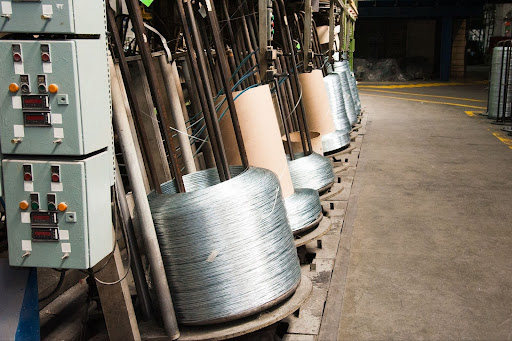
Wire rod is a steel product with a circular cross-section, obtained by hot rolling. Its shape resembles large coils or rolls, making transportation and storage simpler and safer.
Production begins with steel billets which, after controlled heating, are processed in special rolling mills. Here, the steel is stretched and reduced until it reaches diameters between 5.5 mm and 16 mm, varying according to the final use. The result is a flexible material, ready to be transformed into... different items which comprise everything from metal structures to fasteners.
The rolls coming out of the rolling mill are delivered to manufacturing industries. There, the wire rod serves as the basis for various operations, such as wire drawing (diameter reduction), annealing (heat treatment to adjust malleability), and specific cuts. From these processes, items such as the following are manufactured:
Each product retains some of the original properties of wire rod, from tensile strength to weldability, ensuring performance in structural, industrial, and fine finishing applications.
One of the secrets to the success of this input within the steel supply chain lies in quality standard. Standardized use ensures accuracy in projects, logistical ease, and, above all, predictable performance. Key advantages of standardized wire rod include:
In civil construction, the use of wire rod influences everything from vertical structures to small finishing details. Data from the IBGE (Brazilian Institute of Geography and Statistics) shows that..., In 2018, building construction accounted for 45.51% of the sector's activities., And the demand for products such as reinforcing bars and trusses, direct derivatives of wire rod, was crucial in ensuring safe construction and efficient projects.
Among the main applications, the following stand out:
Recent studies indicate that, In 2023, Specialized Construction Services accounted for 24% of the total value of construction projects., reflecting the growing need for reliable inputs such as screens, trusses, and wires derived from wire rod.
In the manufacturing industry, wire rod is taking on new forms. The automotive, metallurgical, and consumer goods sectors absorb a large portion of production, converting the wire into components that demand impeccable finishing and tight tolerances. Some examples:
According to surveys by IBGE, Between 2010 and 2019, the share of products such as nails and screws in the value generated by the sector increased.. This trend reinforces the reliance on wire rod to guarantee performance and reliability for the end consumer.
Wire rod is surprisingly adaptable. Its applications transcend industrial boundaries. See examples of how this material is used daily by companies in various sectors:
In the agricultural industry, the material is widely used in cabling for electric fences, wire mesh, agricultural greenhouses, and irrigation systems. Its mechanical strength and durability help ensure protection, perimeter control, and the proper functioning of rural structures, even under constant exposure to the elements.
In the energy sector, its use includes the manufacture of conductor cables, supports for transmission towers, and insulating components. These elements require high strength, precision, and stability, as they are part of essential systems for electrical distribution on an industrial and urban scale.
In urban infrastructure projects, the material is used in the production of protective railings, wall screens, containment barriers, and fencing for public roads or highways. Its versatility allows for the creation of security and urban space organization solutions with a long lifespan and easy maintenance.
In metalworking, it is a fundamental input for the manufacture of gates, window and door frames, handrails, and stair structures. Its malleability and resistance allow for the creation of functional pieces that are aesthetically aligned with the needs of residences, businesses, and various architectural projects.
This flexibility positions wire rod as a fundamental tool in diverse production processes, whether for large-scale projects or on-demand solutions for regional clients and projects.
What makes wire rod so valuable? Several technical characteristics stand out:
These advantages directly impact the final quality of products and the technical feasibility of projects. And, by adopting suppliers committed to standards and process control, such as the Aço Cearense Group, companies guarantee traceability, agility, and support in the replacement or eventual customization of inputs for specific demands.
To delve even deeper into these benefits, a recommended read is the content on the advantages and applications of steel in civil construction, which reveals how wire rod is part of the success in different projects.
Technical factors, such as chemical composition, hardness, surface finish, and certification, cannot be ignored. A wire rod suitable for manufacturing nails may not be ideal for high-tensile applications in cables or special structures.
The secret lies in the combination of appropriate technical specifications and supplier expertise. A good partner delivers more than just the raw materials: they offer consulting and complete solutions.
Wire rod, despite its quiet operation on the production line, forms part of the foundation upon which much of the national construction and industrial sector rests. Its presence transforms projects, adds value to the production chain, and creates opportunities for innovation, always focusing on safety, quality, and responsibility.
Leading companies, such as Grupo Aço Cearense, are at the forefront of delivering solutions that combine technology, efficiency, and social commitment, ensuring that each roll of wire rod carries not only steel, but also confidence in the market.
Want to learn more about smart wire rod applications and acquire certified products tailored to your company's needs? Check out our product catalog!
Wire rod is a circular cross-section steel product, manufactured by hot rolling steel billets. It offers versatility for transformation into items such as wires, nails, screws, trusses, and reinforcing bars. Its strength and formability properties make it a key component in the steel industry.
In industry, it serves as raw material for the production of technical parts such as screws, cables, springs, welding wires, nails, and staples. Its characteristics allow for the efficient manufacture of structural and fastening components, meeting varied demands in sectors such as automotive, metallurgical, consumer goods, and agribusiness.
In civil construction, wire rod is the basis for reinforcing bars, welded wire mesh, trusses, tying and fastening wires, as well as nails used in construction. These products reinforce concrete, structure slabs, connect building elements, and ensure the structural safety of residential, commercial, and industrial buildings.
To make the right choice, evaluate the end use (structural, fastening, or finishing), strength requirements, compliance with technical standards, origin, and supplier quality. Request reports and traceability data, and seek specialized technical guidance for very specific applications.
Companies with a long tradition, certifications, and a commitment to environmental responsibility, such as Grupo Aço Cearense, offer high-quality wire rod for various B2B market demands. Always look for suppliers that guarantee standardization, technical assistance, and efficient delivery.