Alloy steel is widely used in construction and industry. It is a material composed of iron and carbon alloys and is used in the manufacture of a wide range of products, including household appliances, vehicles, construction materials, and more.
Steel is very popular and widely used, with its mechanical properties being one of the reasons it is so widely used. These properties vary depending on the different types of material and their compositions.
If you're interested in learning more about steel, its applications, and the main types of steel used in industry, keep reading this article, because it will answer all your questions! Let's get started!
To begin with, all steel contains carbon, but when the product needs to achieve other mechanical properties that common carbon steel does not achieve, alloying elements — chromium, nickel, copper, among others — are added to the chemical composition.
So, learn a little about the classifications now. of these materials which differ in composition:
This type of steel is formed by an alloy of iron and carbon, where the carbon content in this case is less than 2.11%. All products derived solely from the combination of iron and carbon—the content of the element may vary—without significant amounts of other elements in the composition are called carbon steel.
This type of steel typically contains trace elements such as manganese, phosphorus, or silicon, but the amounts are not sufficient to alter its properties. Carbon steels are widely used in a variety of applications.
Below is a list of variations in carbon content in this type of steel:
Alloy steels, on the other hand, contain, in addition to iron-carbon bonds, other elements in significant proportions that can alter the material's chemical or mechanical properties. Typically, the other elements added to the steel's composition are manganese, nickel, chromium, molybdenum, vanadium, tungsten, and silicon. This depends on the desired properties of the steel.
These elements are normally used to increase the hardness and mechanical or chemical resistance of steel or to give it other properties that are interesting for its application.
Alloy steels are also divided according to the element content in their composition:
Another common classification for steel grades refers to their intended application. Here are some of the most common classifications. Stay tuned!
They are very important in the construction industry because they have high mechanical strength and can withstand heavy loads. structural steels They are typically carbon steels or steels with small amounts of alloying elements. This group includes ASTM A36 steel, which is widely used by many construction companies.
These types of steel are most commonly used in Brazil in reinforced concrete structures. Because concrete has high compressive strength, the steel inserted into the structure provides good tensile strength. In addition to providing good adhesion to concrete, the steel also exhibits deformations compatible with the material.
The most commonly used structural steels are CA-50 and CA-60, whose yield strengths are 50 kgf/mm² and 60 kgf/mm², respectively.
The steels used to manufacture springs have a high elastic limit, meaning they can withstand forces and stresses without permanent deformation. Most spring steels are carbon steels, with alloys only necessary in special situations.
It is the material used to produce cast steel parts. In this process, liquid steel is poured into molds and takes the shape of the cavity as it solidifies. These can be carbon or alloy steel, as long as they have good strength.
This type of steel is used in mechanical engineering, making forged parts, bearings, shafts, gears, and more. Mechanical engineering steels are carbon or low-alloy steels and cover a wide range of products.
In addition to these applications, there are several classes, such as steels for machining, rails, electrical purposes and others.
Another classification for steel is its geometry, which depends on the processing the product underwent at the steel mill. Typically, they are divided into three groups: semi-finished products, flat products, and long products. Learn a little more about each of them!
One of the final stages of steel production before finishing is called casting. During casting, liquid steel from the blast furnace is distributed into molds, where it solidifies.
At the end of the casting process, so-called semi-finished products are produced, which can be blooms, billets or slabs.
To manufacture flat products, they go through a process called rolling, when the semi-finished material that has just come out of the casting process has to pass through two cylinders.
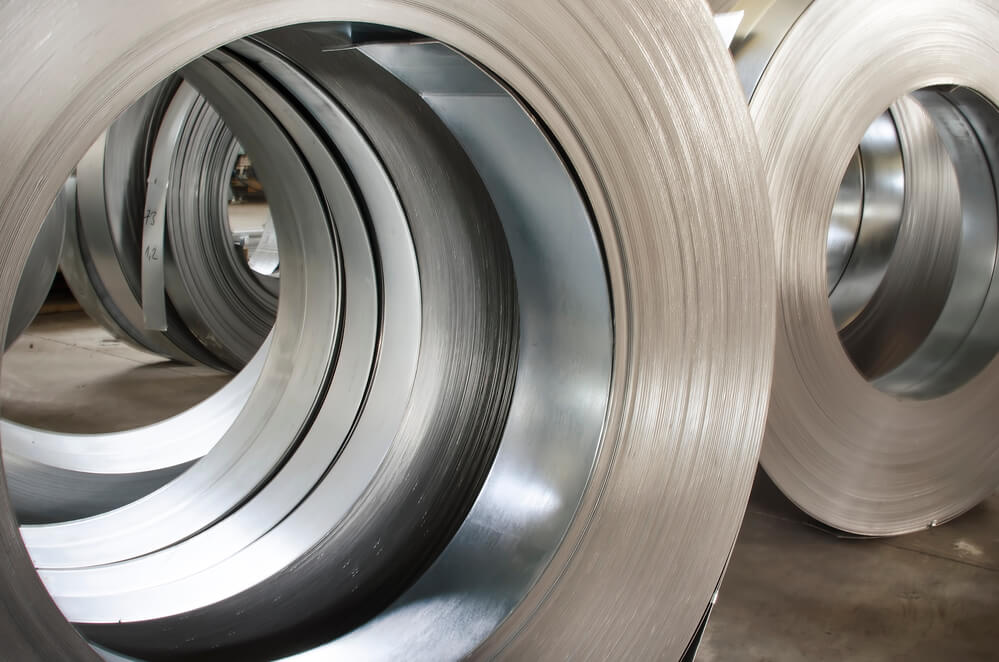
The cylinders rotate, applying a compressive force to the material. The end result of this force is a final plate that can later become a sheet or steel coil.
Sheets and coils can be made of pure carbon steel or coated steels—painted, zinc-plated, galvanized, etc.—stainless steel, or other types of alloy steel. Some of the main flat products are:
Long products can also be obtained through rolling. However, their main characteristic is that their length is much greater than their width and height. They are typically sold as bars, wires, tubes, rebars, profiles, and angles. Learn about some of the most common types:
Now that you've seen the classifications of steel according to various factors, see which steels are most commonly produced in industries and how they are produced.
Steel sheets can be hot-rolled or cold-rolled. Hot-rolled sheets are manufactured at temperatures exceeding 900°C, resulting in hot-rolled coils. After this process, the product undergoes the uncoiling process, where the sheets are cut crosswise and then delivered ready-to-use. This type of steel is used as a raw material for the production of metal pipes, auto parts, wheels, and more.
Cold-rolled sheets are produced at temperatures below 100°C. They are more malleable, but not less durable, and can be finished in a variety of ways. Because of this, they're used in home appliances, automobiles, construction frames, and more.
The main difference between the two types is in the manufacturing processes, as cold-rolled steel goes through more stages than hot-rolled steel.
Galvanized steel is a material that undergoes the galvanizing process, which increases its resistance. Galvanizing involves immersing steel in molten zinc, which ensures the product's resistance to corrosionThe main use of this material is in the manufacture of pipes, support beams, and other applications in civil construction.
Galvalume steel is a type of alloy steel composed of zinc, silicon, and aluminum. This material is excellent in corrosion resistance and has a service life four times longer than galvanized steel. For this reason, galvalume steel is widely used in aggressive environments, such as in industry and the marine industry. It offers greater aesthetic appeal and is widely used in construction, such as metal roofing tiles.
Stainless steels, or simply stainless steel, is the production of steel with the addition of chromium and nickel, made in a blast furnace from pig iron. Stainless steel, in addition to resisting atmospheric corrosion, is resistant to several other chemicals.
Therefore, it has a wide range of applications, both in construction—used in piping, equipment components, etc.—and in other sectors. Stainless steel maintains its attractive shine for a long time, requiring only simple cleaning.
It is a type of material that withstands high temperatures and has very high mechanical resistance, and can be used in the production of furnaces, combustion chambers, machines of various types, among others.
As you can see, steel comes in countless types, geometries, and a wide variety of applications. It's one of the most consumed materials in Brazil and around the world, driving the economy and creating thousands of jobs. It's important to rely on partners and suppliers who value product quality and ensure reliable logistics.
Want to learn more about alloy steel types, diversify your product range, and expand your business? Then contact us and see how we can help you!
 EN
EN  PT_BR
PT_BR