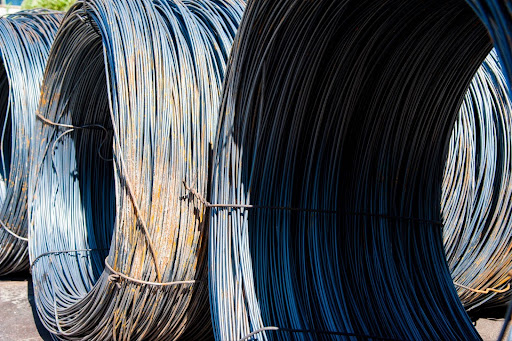
Accurate material calculations are one of the cornerstones of successful budgeting for any construction project. In the context of civil construction, Knowing exactly how much annealed wire will be needed for masonry makes a difference in costs, site organization, and the final delivery of the project.
From small renovations to large buildings, this material is present, mainly in the tying of blocks, laying of bricks, and fixing of rebar. Grupo Aço Cearense, one of the leading suppliers of steel solutions for construction, understands this need well.
In this article, we'll discuss how properly calculated wire spacing prevents waste and rework on the construction site.
Annealed wire, resulting from a steel annealing process, possesses superior malleability, allowing for twisting without risk of breakage. Its flexibility facilitates firm and secure bindings, even in adverse situations.
Unlike galvanized wire, which offers corrosion protection, annealed wire focuses on practicality and low cost, making it the preferred choice for projects of all sizes. Its use represents significant savings for those seeking structural efficiency without compromising safety.
Annealed wire is known for its malleability, which makes it easy to cut and tie. Even teams with little experience can use it effectively, reducing the learning curve and increasing productivity on the construction site.
With more meters per kilogram, annealed wire provides high yield, which means more precise and economical planning is possible. This avoids excessive material purchases and helps keep costs under control.
Compared to other wire options, annealed wire stands out as a more economical alternative. Its use contributes to cost reduction in construction projects, allowing builders and engineers to maintain more balanced budgets.
Available in rolls and pieces of various weights, annealed wire offers flexibility in choosing the most suitable format for each type of project. This facilitates transport and storage, as well as allowing for better adaptation to project needs.
The malleability of annealed wire gives it the ability to adapt to different needs on the construction site. Whether for simple or complex ties, it can be shaped according to the requirements of the project, ensuring structural integrity.
Planning begins with project analysis. It is essential to consider the type of masonry, wall dimensions, brick/block specifications, bonding spacing, and reinforcement composition.
Here's how to perform the calculation in different situations:
Consumption varies depending on the bonding pattern (horizontal or vertical) and the type of element used. For standard projects using ceramic or concrete blocks, the following reasoning is recommended:
A wall 10 meters long and 2.7 meters high, with wires tying strands together every 0.45 meters.
From the total length, convert to weight, considering that 1 kg of annealed No. 18 yarn yields, on average, 33 linear meters. Thus, for 66 meters, approximately 2 kg will be needed.
Reinforcing steel, especially in columns, beams, and slabs, requires a different type of anchoring.
Generally, pieces of wire about 20 cm long are used for each knot, at all points where steel bars meet. SEINFRA This indicates an average consumption of 0.022 kg per unit built in masonry grease/soap traps.
In a practical example, to tie together the intersections of 50 stirrups, with 4 points each, the following would be needed:
Small changes to these routines can already lead to cost savings throughout the project and a cleaner construction site. Standardizing the use of twine transforms daily life on the construction site and reduces the final cost of the project. Check out our tips:
Choosing the best wire for each stage involves analyzing its mechanical strength, durability, and cost.
Galvanized steel, with its corrosion protection, tends to be more expensive and was traditionally required only in special situations or when exposed to the elements. Annealed steel, on the other hand, offers excellent performance for internal bracing in dry environments and is more affordable.
For most masonry applications, annealed steel is seen as the most efficient and cost-effective alternative.
Those seeking to deepen their knowledge of applications in structural steel You can consult the different structural steel options, which are essential for defining not only the type of wire, but also its integration with other materials such as rebar and mesh.
Construction projects using standardized annealed wire result in more organized worksites, less waste, and faster tying. With clear methods for the team, the result is evident in both lower consumption and the quality of the service delivered. The material yield per kilogram depends on the thickness of the wire used, reinforcing the need for planning with reliable suppliers.
Calculating the amount of annealed wire needed for masonry work requires attention to project details, the type of work, and the structural dimensions. Simple formulas, applying safety factors, and the habit of recording consumption help transform the experience on the construction site. The choice of annealed wire is justified by its cost, yield, and simplicity. To guarantee performance, it is always recommended to use suppliers that offer technical support and standardized products.
The Aço Cearense Group maintains a specialized structure to support companies, builders, and self-employed professionals in the correct selection and consumption of steel materials. Learn more about our services. product catalog Request a quote today!
Annealed wire is a steel wire that has undergone controlled heating to gain greater malleability. It is mainly used for tying steel blocks and bars together in concrete structures, being efficient due to its ease of shaping, twisting, and joining elements in masonry work.
To calculate, you need to divide the total length of the joints or ties by the meters that each kilogram of yarn yields. For example, if a roll of #18 yarn yields 33 meters per kilogram, a demand of 66 meters will require approximately 2 kg.
Annealed wire offers malleability and low cost, recommended for dry, indoor environments. Galvanized wire, on the other hand, receives a zinc coating to resist corrosion, making it more expensive and used in areas exposed to moisture. Annealed wire is generally chosen for masonry tying due to its better performance and more affordable price.
The price of annealed wire varies according to diameter, quantity, and region. Generally, it is one of the most economical options on the construction market, contributing to cost reduction in both large and small projects.
Companies with a long tradition in the sector, such as Grupo Aço Cearense, offer standardized, tested annealed wires ready to meet the demands of construction projects in the North and Northeast regions of Brazil. Choosing a reliable supplier guarantees not only quality but also technical support to answer questions about consumption and applications.
 EN
EN  PT_BR
PT_BR