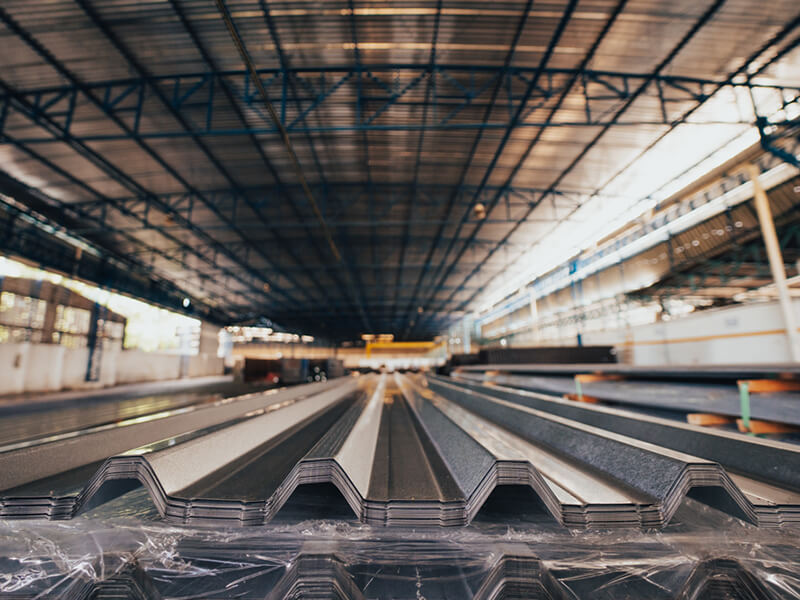
A tile is a product molded from flat galvanized or aluzinc (zincalume) steel. In the former, there is a zinc coating for corrosion protection. In the latter, the zincalume tile is coated with zinc and aluminum, which increases corrosion resistance and provides greater durability.
Zincalume tiles are used for roofing and siding of buildings, residences, and industrial and commercial facilities of various sizes. This is due to their properties, such as thermal insulation, long lifespan, ease of installation, protection, and aesthetics, as well as two basic geometric shapes: corrugated and trapezoidal.
As you can see, the advantages of using this product are immense. However, we want to emphasize that it's important to consider the appropriate environment for installing the tiles and other products. Relax: we'll explain these aspects in more detail. Keep reading!
This is a type of steel roofing material coated with compounds other than zinc, as is the case with galvanized steel. Thus, zincalume also contains aluminum. This coating ensures resistance superior corrosion resistance and durability compared to traditional galvanized steel coated with pure zinc.
Zinc roofing is popular in many countries—including France, Belgium, and Germany. This is due to its longevity, resistance to rust and corrosion, and ability to withstand harsh weather conditions.
Thus, galvanized roofing is commonly used in residential, commercial, and industrial buildings. Furthermore, it is available in a variety of colors and profiles to suit different architectural styles.
However, zinc and aluminum roofing—Zincalume tiles—has gained popularity in recent years. After all, it's a more durable option than traditional zinc-coated roofing.
Some of them are:
The price varies depending on several factors, such as size, model, region of sale, quantity purchased, and market availability. However, in general, zincalume tiles can be slightly more expensive than other types of tiles, such as galvanized tiles.
However, consider the quality and durability of the material, which can be determining factors in cost-benefit of the product in the long term.
These products are not recommended for use in environments with high sulfur concentrations. After all, the conditions for corrosion* are favorable. This is the case in brickworks, an industry that produces bricks, tiles, and other ceramic materials.
In this production process, burning occurs, which generates gases such as sulfur, creating an environment conducive to corrosion. Therefore, the tiles in steel They are not the most recommended product lines, especially those closest to the gas emission source (ovens).
The release of SO2 (sulfur) occurs primarily during activities such as coal burning, which, when exposed to oxygen, transforms into sulfur dioxide and sulfur trioxide. When reacting with moisture in the air, it forms sulfuric acid, which can then react with ammonia in the air to form ammonium sulfate.
All these gases formed, when in contact with metal structures, are responsible for accelerating the corrosive process.
Knowing this helps you choose the best material for your construction projects, renovations, and other spaces. Zincalume tiles are recommended for other roofing applications in buildings and constructions in general, whether residential, commercial, or industrial.
Yes! After all, these processes reduce contact with non-metallic substances present in the environment, such as O₂, S, H₂S, CO₂, and others. However, both the zinc in the coating and the paint are consumed by contact with these substances, leaving the material unprotected.
Therefore, galvanized and/or painted materials have a longer useful life. However, it is not possible to estimate the time, as the degradation rate may be faster or slower depending on the environment in which the material was placed.
The main difference between zincalume and galvalume tiles is their chemical composition: the former is coated with a layer of zinc (Zn) and aluminum (Al), while galvalume tiles are coated with a layer of aluminum (Al), zinc (Zn), and silicon (Si).
Zinc and aluminum—present in zincalume—provide high resistance to corrosion and oxidation, ensuring the tile's long-lasting durability. Meanwhile, the addition of silicon, present in galvalume, improves adhesion between the coating and the steel. This provides greater resistance to corrosion and oxidation, as well as improved heat resistance.
The choice depends on the needs and specificities of each project, as well as the climatic and environmental conditions in which the roof will be installed. After all, both options offer high resistance to corrosion and oxidation. However, galvalume offers greater thermal and mechanical resistance.
Therefore, in general, galvalume tiles are stronger and more durable than zincalume, but they tend to be slightly more expensive. It's important to remember that choosing a quality material and proper installation are essential to ensuring the roof's durability and efficiency.
So, have you answered your main questions about zincalume tiles and how they differ from traditional galvanized and galvalume tiles? As you can see, they all offer positive aspects. So, the choice depends on the project's budget, environmental conditions, and climate. With Aço Cearense, you get high-quality tiles with special treatments for durability and corrosion resistance.
Did you enjoy learning more about zincalume tiles? Read other blog content and learn more about the Aço Cearense Group on our website!
* Corrosion is a natural process in metals, consisting of the deterioration of materials due to the chemical or electrochemical action of the environment, which may or may not be associated with mechanical stress. In corrosion processes, metals react with non-metallic substances present in the environment, such as O₂, S₂, H₂S, CO₂, and others, producing compounds similar to those found in nature, from which they were extracted. Therefore, it can be interpreted that corrosion corresponds to the inverse of the metallurgical process.
 EN
EN  PT_BR
PT_BR