Choosing the best materials for roofing a house, shop, or warehouse is crucial to ensuring its integrity, protection, and comfort. There are many options available today, with different shapes and applications. One of the most common is the trapezoidal tile, which effectively meets the needs of your project.
Understanding the qualities and specificities of each item used in construction is essential when making this choice. Considering the versatility and practicality of the alternative we'll cover in this article, you're likely to be able to meet your project's requirements with excellence.
Continue reading to learn more about this tile option, its qualities, the main types available, and where to use them!
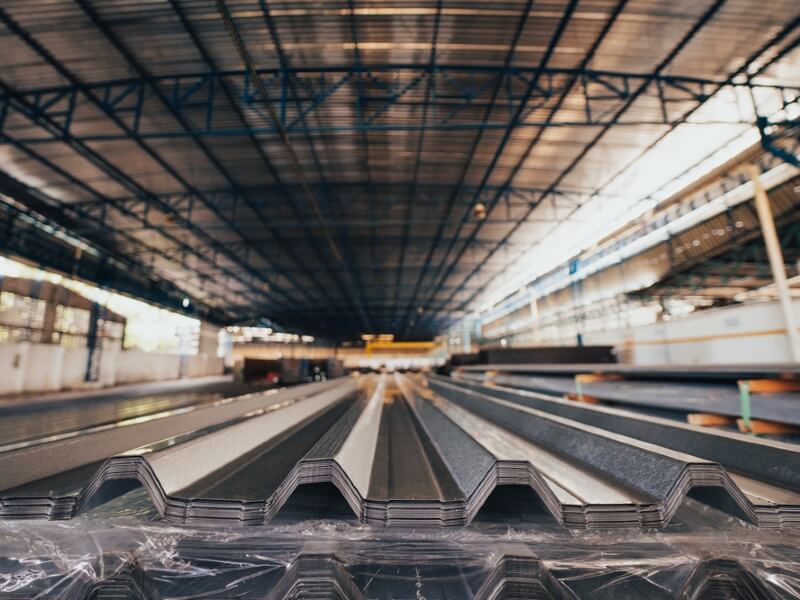
As the name suggests, this material has a standardized trapezoidal shape, creating a very distinctive aesthetic. Furthermore, it is usually made of steel—for example, zincalume —, featuring a thin thickness and composition similar to that of a common metal sheet. Its design, however, provides greater strength and efficiency.
It's a versatile and efficient option for a variety of structures—not just roofs. You can find it in residential buildings, commercial buildings, warehouses, and more.
Trapezoidal tiles have a wide range of applications, making them ideal for a variety of projects. Below, we'll look at some of their main uses and how they deliver the best results!
Without a doubt, the most common use of these metal tiles is in roofing and coverings, protecting the structure from rain and sun. In this case, metals with greater resistance and durability are used, such as galvalume.
It can be applied to a building's slab to create a protective layer and prevent wear. Installation tends to be simpler than traditional clay slabs, for example—which are more prone to falling or cracking.
Trapezoidal tiles can often be used alone to create awnings or canopies. This is because they provide a protective layer that doesn't necessarily enclose the rest of the structure, requiring only a skeleton for support.
In addition to being applied to a roof covering or awning, they can also be used to fill the facade of a building—whether as an awning or as an extra layer of protection. Once again, their use serves to preserve the structure itself, minimizing the impact of light, water, and wind.
A facade made with metal tiles is more durable, but requires additional care. For example, reflected sunlight can negatively impact comfort in the surrounding area. To address this, it's common to use metals more matte or the use of paint to cover the mirrored surface — something very common and not very difficult to implement.
On roofs or facades, trapezoidal structures are primarily used for protection or covering. However, they can also be part of the structure itself, establishing walls. This is the case, for example, with many warehouses that prioritize a lightweight and resistant format that can be installed and maintained without generating high costs—and are not primarily intended for human use.
With the right materials and some care, it's possible to easily build small structures using these tiles and a metal skeleton—which is already enough to store objects or separate a space, without having to do any more complex construction.
The greatest technologies in civil engineering They are the result of simple changes, such as altering the shape of the chosen elements to make the property more resilient. In this sense, this type of tile is a very effective option for certain buildings.
Discover some of its main advantages for a project!
One of its main qualities is its superior strength compared to a flat metal plate. This is because its shape helps distribute the weight and pressure applied to its surface—so a less rigid metal can support a greater load across its entire length.
In addition to a more efficient design, there is generally the use of steel Galvanized or galvalume—extremely durable metals. When applied correctly, the structure tends to be much more resistant, even under high pressure or temperatures. Proper planning is all it takes to install and use these parts in your project.
Many options can be expensive, either due to the specific characteristics of the material or production difficulties. However, most trapezoidal tiles usually meet all these requirements at a much more affordable price.
One reason, again, is their shape: because the trapezoid increases the overall structure's pressure resistance, it's possible to achieve greater resilience with a smaller amount of metal. Therefore, these parts usually come in thinner sheets.
If you need a lightweight and efficient material to replace ceramic, this is one of the most affordable and effective alternatives.
The trapezoid is a very simple and, at the same time, malleable geometric shape. Therefore, a trapezoidal tile It can include several different measurements in its folds, length and base size — and still fulfill its function without major complications.
When planning any project with these pieces, you can define all their dimensions and order a set tailored specifically to your needs. This means there are no major limitations regarding the shape and structure of what you intend to build.
This customization is also useful when considering aesthetics as part of the environment. In some places, having a thinner roof contributes better to the facade. In others, a wall made of trapezoidal tiles can also add style to the desired look.
One of the challenges in construction Roofing and coverings require transporting instruments, tools, and other equipment—in addition to the objects to be installed—to the top of the building. This is quite complicated, especially when dealing with very heavy items, such as clay or ceramic tiles.
This increases the risk of accidents during installation, making the process more time-consuming. In these cases, metal trapezoidal beams are an excellent alternative because they are lightweight compared to other materials.
Furthermore, they're much easier to transport and store. They also offer quick installation, minimizing any risks and maximizing your time—a crucial step if you want the project completed quickly.
There are several types of metal tiles available, each with its own particularities and applications. One of the qualities that must be taken into account is their aesthetic finish: how they impact the architecture, the facade, and your visual comfort.
In the case of trapezoidal roofs, they have the advantage of being discreet compared to other options, as they are very thin and simple. Many places even hide the metal roofing, taking advantage of its functionality and strength without impacting the desired architectural style.
When combined with matte paints, it can also be used in other spaces without reflecting light. It's a very practical way to increase the resilience of a structure without sacrificing visual appeal.
Having a leaky roof is important for many people, as it helps to take advantage of natural light inside the home. Letting sunlight in during the day also helps maintain the temperature and reduce humidity, which is essential for cleanliness and comfort.
At this point, trapezoidal tiles are a good alternative, as there are several options made with translucent materials. Some can be completely transparent, while others are more diffuse, softening the light that passes through their surface. This way, you can make the most of natural light in your home, but without turning it into a greenhouse—ideal for sustainable buildings.
As with any material, we see here an item that has its limitations and requires some care so that you can make the most of its benefits.
Find out what these points of attention are and how to deal with them below!
We mentioned earlier how lightweight these tiles are, and how quickly they can be installed. However, that doesn't mean the process itself is easy, meaning anyone can do it. Ideally, they should only be installed by specialized professionals to avoid accidents and errors.
Naturally, this can also lead to an increase in the total cost of the project. However, considering the other advantages and the speed of the process, it can be well worth investing in a suitable team to carry out the entire process. Therefore, consider this factor when evaluating the relationship between cost and the benefit of the material.
Another common characteristic of metal roofing—and one you should always consider—is its thermal insulation. In the case of trapezoidal roofing, the elements commonly present in its composition have low thermal inertia, meaning heat or cold from the outside environment tends to be transmitted directly to the inside, resulting in little insulation between the two spaces.
This means that on a very hot day, it doesn't provide adequate protection against the heat. Likewise, it doesn't help with temperature changes on cold, rainy days. Therefore, many sheds are made only with components that tend to be quite hot during the day.
In practice, the solution is quite simple: in addition to the trapezoidal material itself, another material should be used to serve as thermal insulation—the slab may already have this protection, and this material can be used as an additional layer. Furthermore, specific paints are often used for this purpose.
Considering all its qualities, there are some contexts that favor its use. Let's look at some of the most common cases.
As we mentioned, trapezoidal tiles have high resistance to various conditions and wear and tear — something that should be taken into account when planning the construction of external areas, such as the roof or awnings.
In these cases, the metal alternative serves as an additional barrier, protecting against the elements and preventing further wear and tear on the structure itself. Therefore, it's a simple way to improve the durability of a property as a whole.
For smaller spaces—such as small sheds—or backyard coverings, using ceramic or clay as a raw material isn't as advantageous, as this results in pieces that are quite heavy and difficult to install. structure used as a base would have to be more robust, which makes it more expensive.
However, even if the support beams are thin and light, they will still be able to easily support a trapezoidal tile.
Aesthetically, this option is often used to add texture and emphasis to certain walls, in addition to the expected protection. For example, it complements an industrial look, creating a distinctive facade that still conveys the characteristics of a workspace—such as a workshop.
It is also possible to achieve other striking effects by using different colors and interacting with the shadows generated by the reliefs.
As we've seen throughout this article, trapezoidal tiles are simple yet extremely versatile and efficient for roofing and facade construction. If you want to implement them quickly and add high strength to your project, this is one of the best options. However, it's essential to rely on reputable suppliers to ensure high-quality products.
Want to find efficient materials that will contribute to your project? Then check out our product catalog and request a budget with the Aço Cearense Group!
 EN
EN  PT_BR
PT_BR