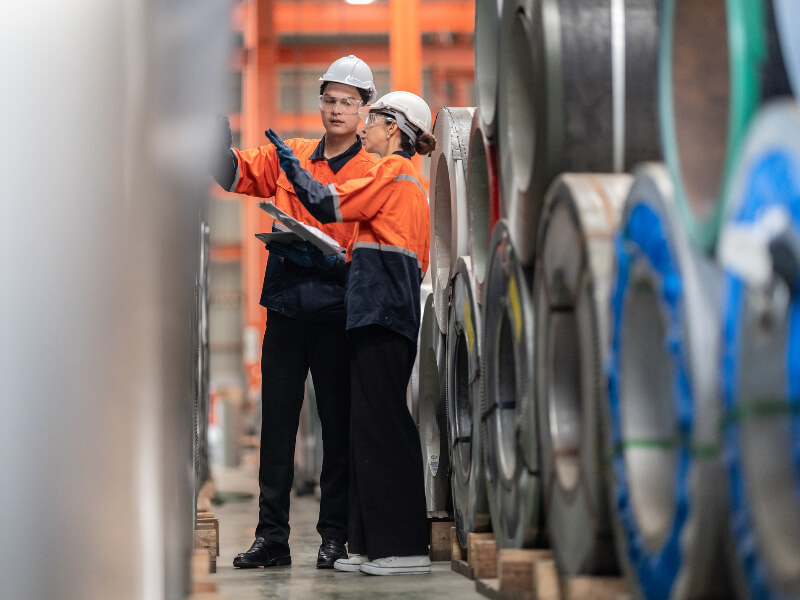
Good management is essential to ensure optimal performance in any company. In the case of iron and steel stores, it's crucial to consider the quantity of products available and how they are circulated. An essential indicator for analyzing your results is inventory turnover.
With this metric in hand, you can better assess your sales efficiency, identify key bottlenecks, and figure out how to address them. This contributes to improving your store's performance and long-term growth.
Learn more about inventory turnover, how it's calculated, its importance, and how you can improve this aspect of your business.
Also called inventory rotation, inventory turnover is an indicator that represents how often your store needs to completely renew its available products. In other words, it's a way to identify the estimated time to deplete your inventory and the average time it takes for a product to be sold.
That stock indicator reflects the efficiency of your management, purchasing process, and sales flow in your store. Monitoring this metric regularly gives your team a more robust basis for planning other aspects of the business.
Calculating a store's inventory turnover is quite simple. Simply measure the total sales volume in a given period and divide it by the average inventory volume for that same period.
The formula is as follows:
Inventory Turnover = Total Sales Volume ÷ Average Inventory Volume
Let's say that, in a given month, your inventory started with a total of 30 units of a product and ended with a total of 50 units, after sales and supply. That same month, your store sold 60 units of the product.
In this context, the average stock was 40 (beginning inventory + ending inventory, divided by 2). Plugging the numbers into the formula, the inventory turnover for this month was 1.5. In other words, your inventory is renewed one and a half times, on average, per month.
Alternatively, you can use inventory value instead of volume. This gives you a better understanding of capital flow in your business.
Let's take another example: your beginning inventory was valued at R$ 10,000 and your ending inventory at R$ 12,000. In the same period, your total sales were R$ 30,000.
Performing the same calculation, we have an average value of R$11,000 and an inventory turnover of approximately 2.7. In other words, the inventory is renewed just under 3 times per cycle.
Closely monitoring inventory turnover, as well as other relevant statistics, is essential to avoid errors when purchasing. manage your inventory. See here some of the positive effects of this control.
Knowing the volume of products you purchase and the quantity you sell each month is essential to ensuring optimal performance in your store. Merchandise movement impacts various aspects of your business, whether it's sales management, storage, or logistics. Accurate data makes strategic decisions easier.
A common problem for many businesses is having a large volume of products sitting in inventory for long periods. This increases their regular expenses, negatively impacting their profitability.
As for the steel storage, these costs can increase considerably. However, by better understanding product circulation, you can plan inventory more in line with consumer demand, reducing much of these expenses.
Inventory turnover is a good indicator for identifying certain market trends and guiding your strategic decisions. Once you understand how often your inventory is renewed, it becomes easier to establish the ideal volume of products for each cycle.
For example, if you identify that your business has low inventory turnover, this may be a sign that you need to promote sales by getting your products moving faster.
In most cases, a high inventory turnover is a good sign for your store, as it means more frequent sales and fewer products sitting idle. Here are some strategies you can adopt to improve this indicator.
The more often you need to replenish your inventory throughout the month, the more important it is to rely on a supplier who delivers on time and high-quality products. It's worth taking the time to explore your options and find the partners that best fit your iron and steel shop's needs.
There's no way to sell a product if customers don't know it exists, right? In many cases, this is the reason for products sitting in your inventory. To rectify this, it's important to invest in measures to improve your sales, such as digital marketing, offers, and other resources that allow you to attract a larger volume of customers in the long term.
Managing a large volume of products is not an easy task. However, it is essential to promote efficient inventory managementTo make this task easier, it's best to use product management software and tools to track each unit and avoid losing control of product circulation in your store.
Now, you better understand what inventory turnover is and its importance for managing your store of iron and steel. With good tools and the right suppliers, you'll have no trouble tracking these numbers and using them in your decision-making.
Want to learn more about this topic and improve your store management? Then check out ideal time to replenish stock in your company!
 EN
EN  PT_BR
PT_BR