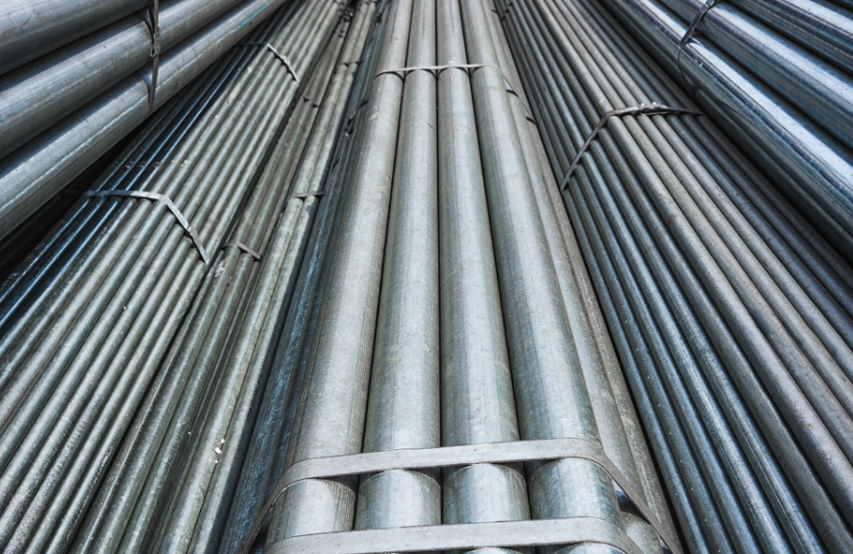
THE Galvanized steel rusts. When the zinc coating loses its ability to protect the base metal. This can happen after long periods of exposure, extensive damage to the coating, or frequent contact with aggressive agents.
Nevertheless, the material offers superior protection compared to uncoated carbon steel. Zinc forms a barrier against moisture and also protects small exposed areas through its sacrificial action.
Durability depends on the environment, coating quality, manufacturing, and maintenance. Therefore, there is no single lifespan that applies to all applications.
Yes, galvanized steel can corrode. However, the zinc slows down the contact between the steel, water, and oxygen.
The coating is gradually consumed during its exposure. When the layer remains continuous, the steel located beneath it remains protected.
The rate of this wear and tear varies depending on the location. A part installed in a dry environment may retain its protection for longer. A structure near the sea, however, is exposed to salt and moisture more frequently.
Furthermore, the lifespan depends on the amount of zinc applied. Coatings obtained through different processes may exhibit varying thicknesses and performance levels.
Therefore, the term galvanized should not be interpreted as an absolute guarantee against rust. It describes a category of protection that needs to be specified according to the application.
Our content about Galvanized steel: advantages and applications It presents other criteria related to the choice of this material.
Galvanization protects steel through three complementary mechanisms. The first is... barrier protection, created by the layer that separates the base metal from the environment.
As long as the coating remains intact, water, oxygen, and contaminants have greater difficulty reaching the steel.
The second mechanism is cathodic protection. Zinc has a greater tendency to oxidize than iron. Therefore, it wears down first and protects small nearby areas where the steel was exposed.
This explains why a superficial scratch doesn't cause immediate rust in all cases. However, the protection has limited reach and doesn't correct extensive damage.
The third mechanism involves the formation of a zinc patina. During wetting and drying cycles, the surface creates compounds that help reduce the rate of corrosion of the coating.
THE ICZ technical manual on hot-dip galvanizing It explains these mechanisms and the criteria for inspecting the material.
Zinc does not remain intact throughout the structure's lifespan. It reacts with the environment and undergoes gradual consumption while protecting the steel.
This loss is part of the coating's normal functioning. The problem arises when the rate of consumption exceeds that considered in the design.
Constant humidity accelerates the reactions. Furthermore, salts, pollutants, and chemicals can alter the surface's behavior.
The coating thickness also influences this. Under similar conditions, a layer with a higher zinc content tends to offer a longer period of protection.
However, comparing only thickness can lead to incomplete conclusions. Different galvanizing processes produce coatings with their own densities, adhesion, and applications.
Therefore, the purchase should consider the type of product and the applicable standard. A continuous-line galvanized sheet has different characteristics from a structure galvanized after its manufacture.
The article about steel galvanizing process It helps to understand how the coating is applied.
The environment determines how long the surface remains wet and what agents come into contact with it. These conditions directly influence its lifespan.
Some scenarios require special attention:
Even two parts of the same structure can face different exposures. A surface washed by rain may accumulate fewer contaminants than one located under a roof.
Therefore, we need to assess the microenvironment. Distance from the sea, ventilation, sunlight exposure, and water retention all affect the material's behavior.
Our content about How does steel corrosion occur? It presents the main agents involved in this process.
Cuts and perforations interrupt the continuity of the coating. The exposed edge may receive some protection from the surrounding zinc.
This action usually addresses minor damage. However, larger areas may exceed the capacity for sacrificial protection.
The tool used also matters. Processes that generate a lot of heat can damage the coating near the edge.
Furthermore, metal shavings should not remain on roofing sheets, plates, or structures. These residues oxidize and create stains that can be mistaken for corrosion of the galvanized product.
After cutting, the team must remove burrs and particles. When the project requires repair, the procedure must use compatible materials.
Zinc-rich paints and metallized coatings can be suitable for certain situations. However, the choice depends on the extent of the damage and the technical specifications.
Simply using a metallic-looking paint does not restore galvanization. Preparation, adhesion, and the amount of zinc must be carefully controlled.
Welding generates heat and removes some of the coating around the joint. As a result, the steel may be directly exposed.
Furthermore, irregular cords create areas that retain water and debris. This geometry makes it difficult to apply repairs uniformly.
The team must clean up slag, spatter, and contaminants after welding. Then, they need to replace the planned protection system.
Whenever possible, cutting and welding should occur before the final galvanizing. This sequence allows the already manufactured part to be coated.
However, structures intended for hot-dip galvanizing need to be designed for the process. Ventilation and drainage holes allow for the circulation of liquids and zinc.
Closed cavities, significant differences in thickness, and incomplete welds can cause problems during galvanizing.
When welding takes place on the construction site, we also need to control the fumes produced by heating the cladding. This activity requires ventilation, appropriate equipment, and trained professionals.
Therefore, Welding should not be treated merely as a mechanical joining process.. It also alters the surface protection.
Zinc remains one of the most widely used coatings for protecting steel. However, the market has also developed solutions with more complete metal alloys.
Some coatings combine zinc and aluminum. Others include additional elements to modify the coating's behavior in the face of corrosion.
Aluminum contributes to barrier protection. Zinc, on the other hand, retains its ability to protect small exposed areas.
These combinations can offer superior performance under certain conditions. That's why they appear in roof tiles, cladding, and components exposed to the elements.
However, we cannot compare products solely based on their brand name. Composition, coating mass, thickness, and intended use must be verified.
Furthermore, performance on flat surfaces does not eliminate the need to consider edges, holes, and welds. The design must take into account how the material will be processed and installed.
Our content about Galvanized sheet metal and its applications This shows how coated products can serve different segments.
The evolution of materials expands the available options. However, the choice still depends on the actual conditions of the project.
The thickness of the sheet metal influences rigidity and mechanical strength. However, it does not prevent corrosion from starting on the surface.
A thicker piece contains a greater amount of steel before section loss becomes critical. Even so, the coating will be worn away under incompatible exposure conditions.
Therefore, increasing the thickness does not replace a proper zinc coating. It also does not correct drainage, maintenance, or manufacturing problems.
We need to separate two criteria. Structural design addresses loads, spans, and stresses. Surface protection responds to the corrosive environment.
These decisions must work together. A tile needs to be thick enough for the span and have a coating compatible with the climate.
The same applies to profiles, pipes, gratings, and lightweight structures. A good specification avoids adding weight without addressing the root cause of the deterioration.
Galvanized products stored wet and without ventilation can develop white deposits. This phenomenon is known as white rust or wet storage stain.
It occurs when moisture remains between sheets, tiles, or stacked pieces. Without air circulation, the surface does not properly complete its drying cycles.
In mild cases, the whitish appearance may not represent a significant loss of protection. Even so, the material needs to be evaluated and dried.
When the condition persists for a long time, zinc consumption can become relevant. Therefore, wet packets should be opened quickly.
The pieces need to be supported, raised off the ground, and sloped sufficiently to allow water to drain. Furthermore, the temporary covering should not completely block ventilation.
Our guide on proper storage of steel It includes precautions to preserve the products before installation.
Inventory should also be managed according to usage order. Storing materials for extended periods increases exposure to damage, moisture, and unnecessary handling.
Durability starts with the specification. We need to identify the environment, the application, and the difficulty of maintenance before purchasing.
Next, the design should avoid areas where water can retain. Slopes, drainage holes, and ventilation help the surface dry.
Fasteners and accessories also need to be compatible. Contact between dissimilar metals can promote galvanic corrosion when moisture is present.
During manufacturing and assembly, cuts and welds must be treated. Deep scratches also need to be assessed.
The structure must remain accessible for inspections. Hidden or sealed parts may deteriorate without visible signs.
In more aggressive environments, we can consider a duplex system, This process combines galvanizing and painting. The paint reduces zinc exposure, while the metallic coating protects the steel.
However, the paint must be compatible with the galvanized surface. Proper cleaning, preparation, and application determine adhesion.
Maintenance should remove accumulated salts, dust, and debris. Additionally, we need to repair damage before corrosion spreads to a larger area.
Visual inspection helps to recognize changes in the surface. However, not every change in appearance indicates immediate failure.
Loss of shine can occur during the natural formation of patina. Reddish spots, on the other hand, indicate that the base steel may be exposed.
Scratches, peeling, and uncoated areas deserve attention. Fasteners, edges, and welded areas tend to show wear sooner.
White deposits also need to be evaluated. They may indicate damp storage or prolonged exposure to water.
In addition, we should look out for dirt buildup, drainage problems, and constant contact with wet materials.
When visual inspection is insufficient to draw a conclusion, coating thickness measurements can supplement the inspection.
The result should be compared with the applicable specifications and technical criteria. This way, we avoid unnecessary repairs or delays in the face of a real problem.
The choice begins with the type of product. Sheets, tubes, profiles, and galvanized parts, after manufacturing, have different characteristics.
Next, we need to assess the exposure. A moderate urban environment does not require the same protection as a coastal or industrial area.
The amount of coating must match this condition. Additionally, the order must specify dimensions, steel thickness, and finish.
The manufacturing process also plays a role. Parts that will undergo numerous cuts or welds may require careful planning to preserve protection.
Another criterion is the availability of maintenance. Tall or hard-to-reach components may justify a system with greater durability.
Finally, we must compare the cost over the lifespan of the vehicle. Repairs, repainting, and replacements are all part of the decision.
THE Aço Cearense product page It offers different options for construction, metalwork, and industrial applications.
Galvanized steel offers efficient protection when the coating is suited to the environment and application. However, cuts, constant moisture, and aggressive agents can reduce its durability.
At Aço Cearense Comercial, we offer steel products for roofing, structures, metalwork, and various civil construction projects.
Discover our options and Download the Aço Cearense catalog. to identify materials that are compatible with the needs of your project.
Loss of shine can occur during the formation of the zinc patina. This visual change alone does not indicate that the coating has lost its protective capacity.
Light deposits can be cleaned using compatible methods. However, the material needs to be evaluated if the white layer is extensive or if there has been prolonged contact with moisture.
No. The fasteners need to be compatible with the coating and the environment. Inappropriate combinations can lead to galvanic corrosion in the assembly.
The repair can utilize zinc-rich paint, metallization, or another method accepted by the specification. The area must be cleaned and prepared before application.
Contact with damp soil can accelerate zinc wear. Suitability depends on soil composition, drainage, and the specified protection system.
Yes. Specific instruments allow for the verification of coating thickness using non-destructive methods. The measurement must follow technical criteria and appropriate sampling points.