Steel is one of the most important materials in engineering, whether in civil construction, vehicle manufacturing, tool manufacturing, or many other fields. This is partly due to the material's wide range of applications, the most common being structural steel.
For those working in construction, this is one of the applications that represents a large portion of projects. Even within this category, it still presents several different types, each suited to specific contexts. Understanding these variations is crucial when deciding which ones to use in your projects.
Follow and understand more about structural steel, its different types, and the standards it must follow.
As the name suggests, it's the steel used to form a structure, whether it's the skeleton of a building, a vehicle, a platform, or a machine. It's also used in moving parts of that structure, such as joints and gears.
In order to be used for this purpose, this steel needs to follow a series of technical specifications, mainly in relation to steel resistance. Material used in contexts other than a structure does not follow these standards.
See below some of the main features.
One thing that's guaranteed in any construction is that its materials are subject to significant pressure and tension from all angles. A building's design must take into account the weight of the structure itself, pedestrians, the impact of wind and rain, and other potential damage.
Therefore, the steel used in these constructions must have highly predictable behavior under these forces. Hence the need for a homogeneous composition, reducing potential unforeseen events in its formation and distortion.
One of the advantages of steel as a structural material is its application flexibility. Depending on its composition, it can be adjusted to meet different demands, tailored to each project. This also includes the possibility of welding it with other steel plates or different materials.
Highly weldable steels offer benefits to any project. This makes the process more practical and eliminates certain structural flaws or vulnerabilities present in the structure as it is assembled.
In addition to welding, structural steel can be shaped and bent as part of its construction. This is the characteristic of workability, which represents the ease of manipulating the material.
Naturally, all material used in the civil construction It must meet a durability standard. This is one of the main reasons steel is so widely used, as it can add strength and rigidity to a structure without adding too much weight. At the same time, it must have some flexibility. Otherwise, any deformation or excessive force can cause irreparable damage.
Structural steel's profile as a durable material extends beyond its immediate use. It is also a 100% recyclable material, meaning it can be removed from a demolished building, reprocessed, and returned to its original state. This significantly reduces its environmental impact, as it does not need to be disposed of with other debris.
As mentioned, there are many types of steel, each with different compositions to suit different purposes. Naturally, there are also numerous types of structural steel with their own qualities.
Learn about the main types and their applications.
This is one of several types of rebar steel used in works and constructions to form the structural base of a property. This variation consists of straight bars with a smooth surface. They are primarily used in the construction of floors and pavements, providing a base for transferring weight to the rest of the structure.
Since it's not directly responsible for supporting the floor, it doesn't require a high level of strength compared to other types. Still, it must be capable of supporting all the material used to form the floor, as well as people and loads present on its surface.
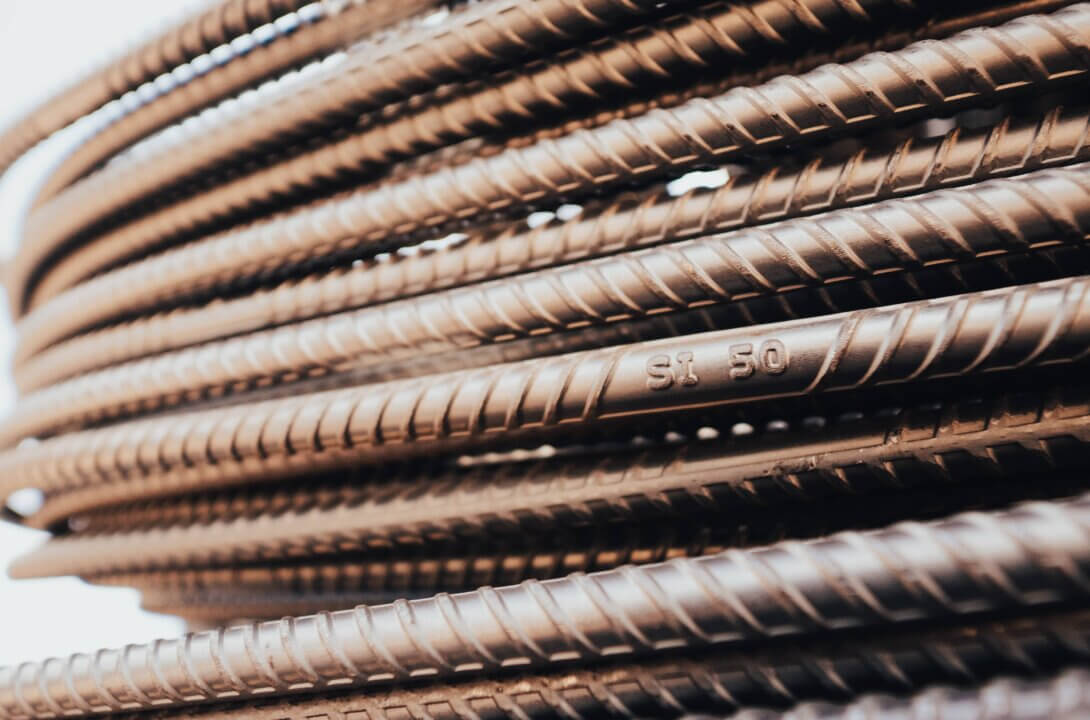
In reinforced concrete constructions, the most common material used is CA-50 steel, which has a ribbed surface. The material has a higher deformation rate, providing more secure support when subjected to high localized pressure. Therefore, it is ideal for slab construction.
Since this type of structural steel carries more weight, it also requires higher strength. Furthermore, it is one of the most weldable types, which can facilitate process of structuring in some projects.
Another steel used in rebar is CA-60. It has the highest strength of these three grades, as well as high weldability. This means it can be used in structuring slabs and other surfaces that require greater strength and rigidity, including in concrete.
Due to its high durability and resistance to deformation, it is the most widely used in the construction of prefabricated structures. It is well-suited for projects that need to be completed quickly and follow a standardized construction model.
When we talk about its composition, one of the factors considered is the carbon content present in the composition of the steel. Depending on the quantity, some of its qualities can also be altered, which changes its application.
The main qualifications are:
Depending on the project's purpose, different steel grades can be used to assemble more complex structures. For example, A36 structural steel, a low-carbon steel widely used in welding and machining, is available.
This type of steel includes several other elements in its composition, forming a metallic alloy. It can include varying amounts of nickel, manganese, silicon, or tungsten, for example. Depending on which elements are added and their quantity, the steel acquires different qualities, which may be more suitable for certain applications.
Structural steel is quite versatile, with variations for each type of application. When contacting your steel supplier, keep in mind these differences and what purposes they serve in your work.
And if you want to find high quality steel, check out the products of the Aço Cearense Group right now!
 EN
EN  PT_BR
PT_BR